Primary visual cortex
The visual cortex of the brain is part of the cerebral cortex and processes visual information. It is in the occipital lobe at the back of the head.
Visual information coming from the eyes goes through the lateral geniculate nucleus within the thalamus and then continues towards the point where it enters the brain. The point where the visual cortex receives sensory inputs is also the point where there is a vast expansion in the number of neurons.
Both cerebral hemispheres contain a visual cortex. The visual cortex in the left hemisphere receives signals from the right visual field, and the visual cortex in the right hemisphere receives signals from the left visual field.
[Cerebral hemispheres, occipital lobes, primary visual cortex, optical radiations]
The visual cortex of the brain is part of the cerebral cortex and processes visual information. It is in the occipital lobe at the back of the head.
- Visual information from the eyes goes through the lateral geniculate nucleus within the thalamus and then continues towards the point where it enters the brain. At the point where the visual cortex receives sensory inputs is also a point where there is a vast expansion of the number of neurons
- Both cerebral hemispheres contain a visual cortex. The visual cortex in the left hemisphere receives signals from the right visual field, and the visual cortex in the right hemisphere receives signals from the left visual field.
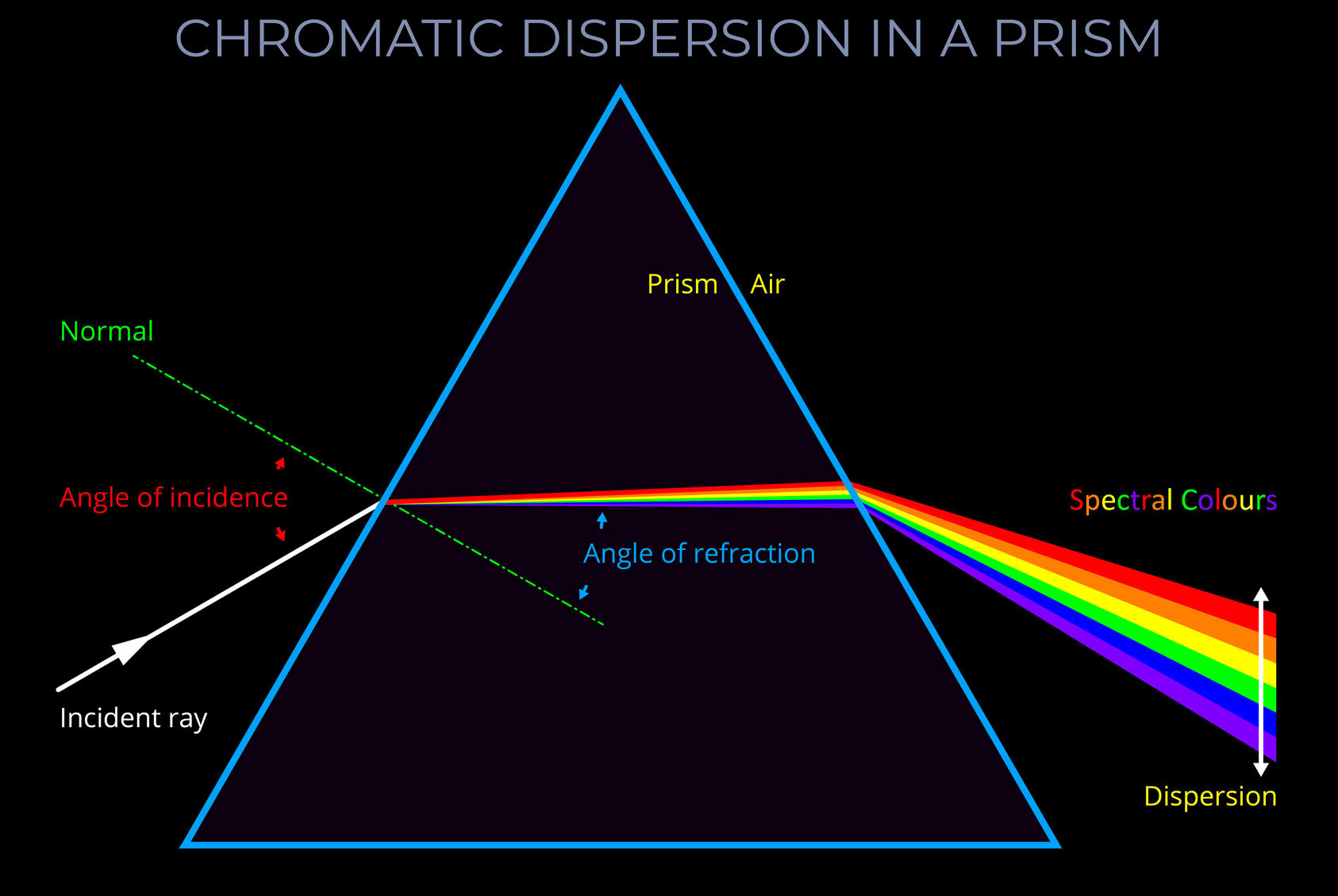
In the field of optics, a prism is an object made of glass or other transparent material with flat, polished surfaces.
- Prisms are often used for experimental purposes to study the refraction and dispersion of light.
- They are popularly known to split light into rainbow colours.
- A triangular prism consists of two triangular ends and three rectangular faces.
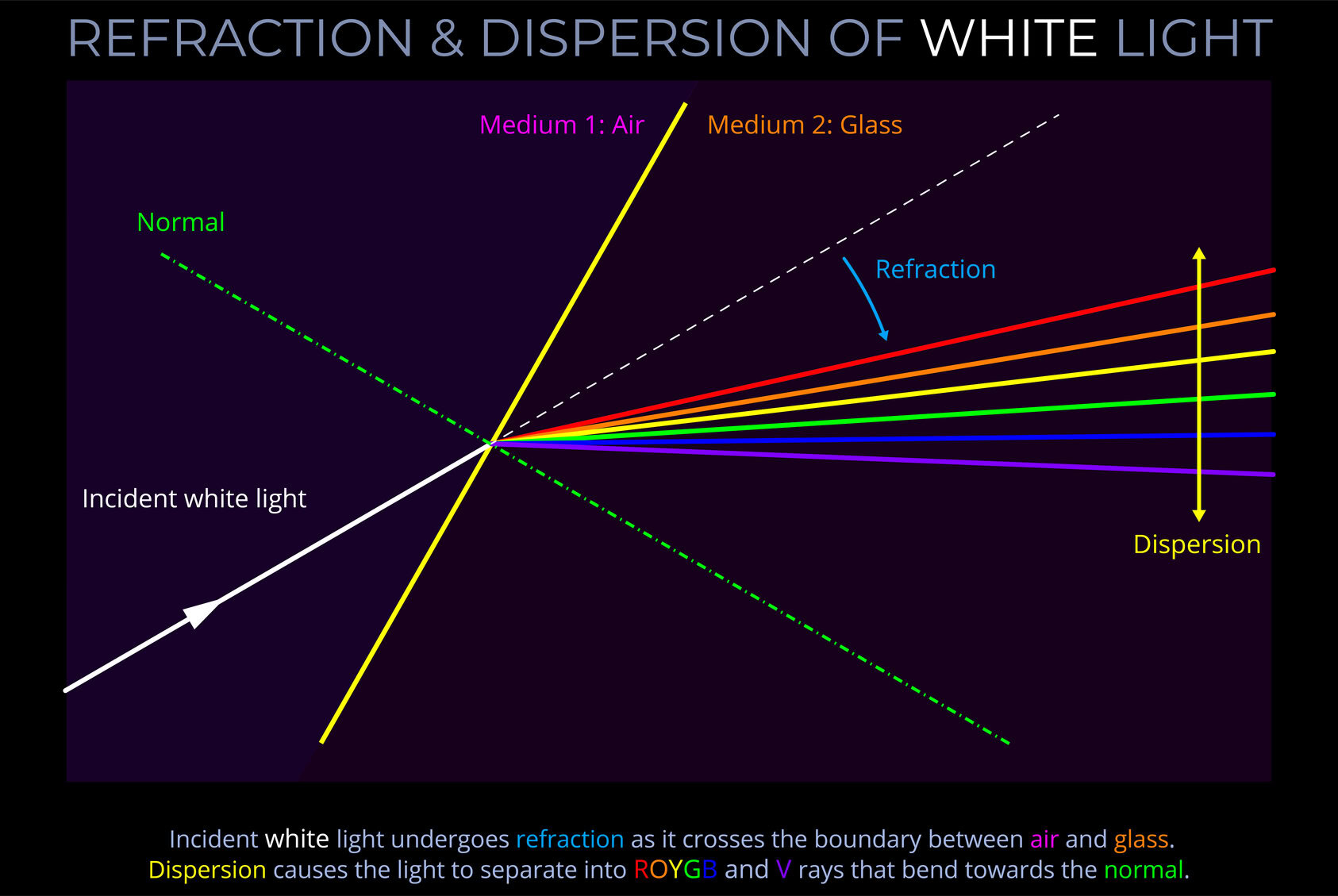
- If white light is to be refracted or dispersed by a prism into its component colours a narrow beam is pointed towards one of the rectangular faces.
- Dispersive prisms are used to break up light into its constituent spectral colours.
- Reflective prisms are used to reflect light, to flip or invert a light beam.
- Triangular reflective prisms are a common component of cameras, binoculars and microscopes.
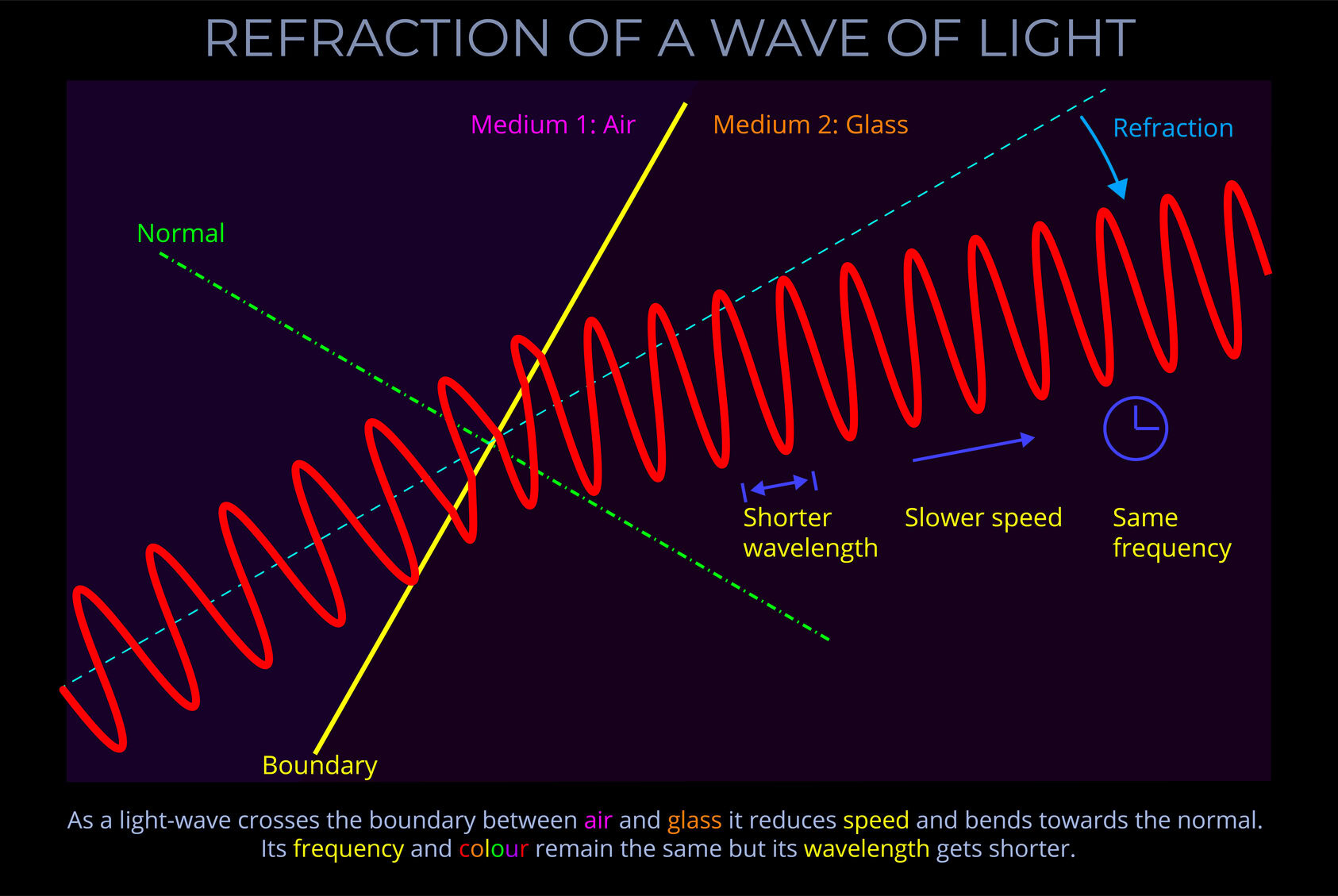
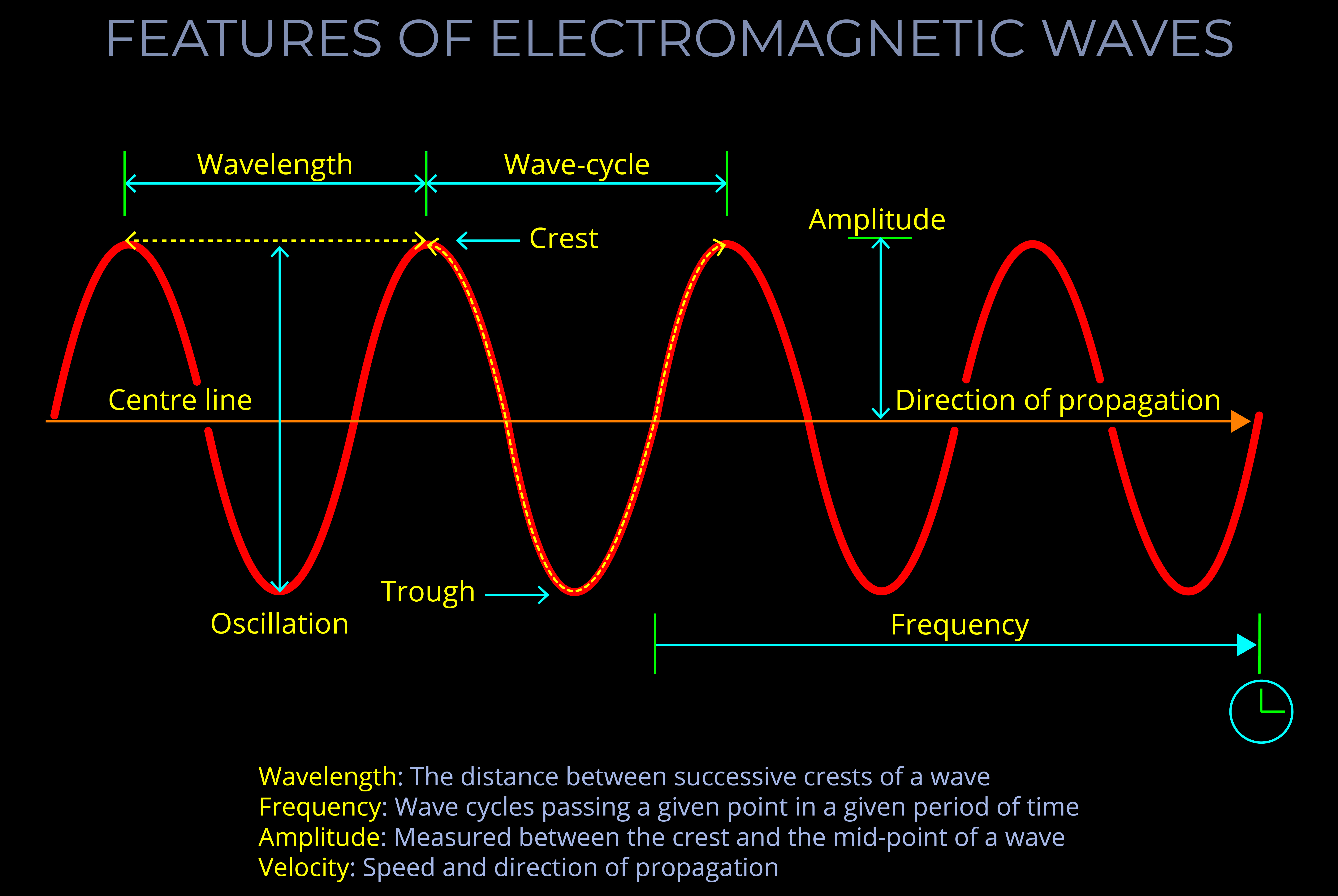
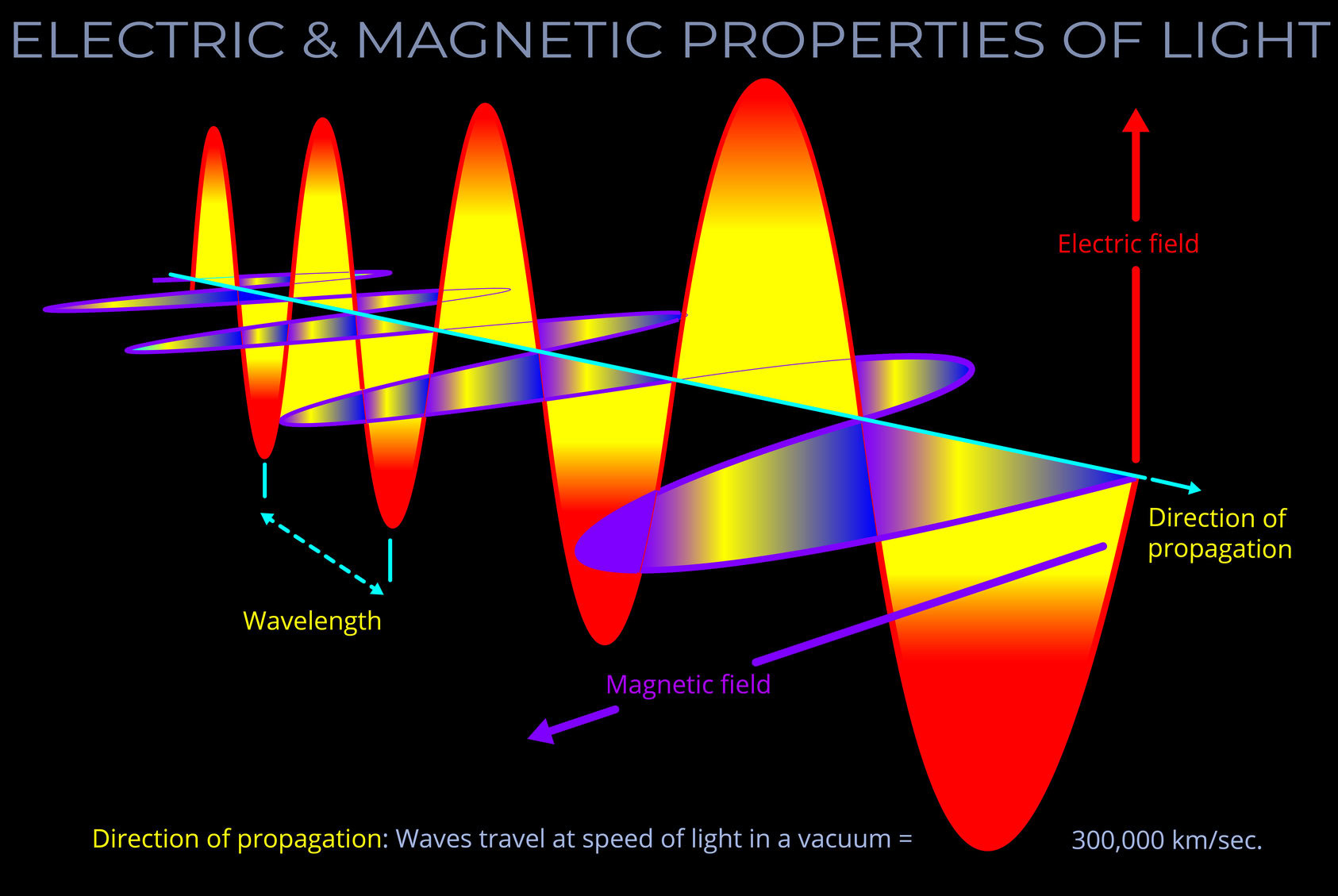
Wave propagation refers to any of the ways in which waves travel.
- Electromagnetic radiation propagates through space, carrying electromagnetic energy in the form of electromagnetic waves.
- The propagation of electromagnetic radiation through space is sometimes described in terms of photons rather than waves.
- Photons are particles that are sometimes used to explain the behaviour of electromagnetic waves.
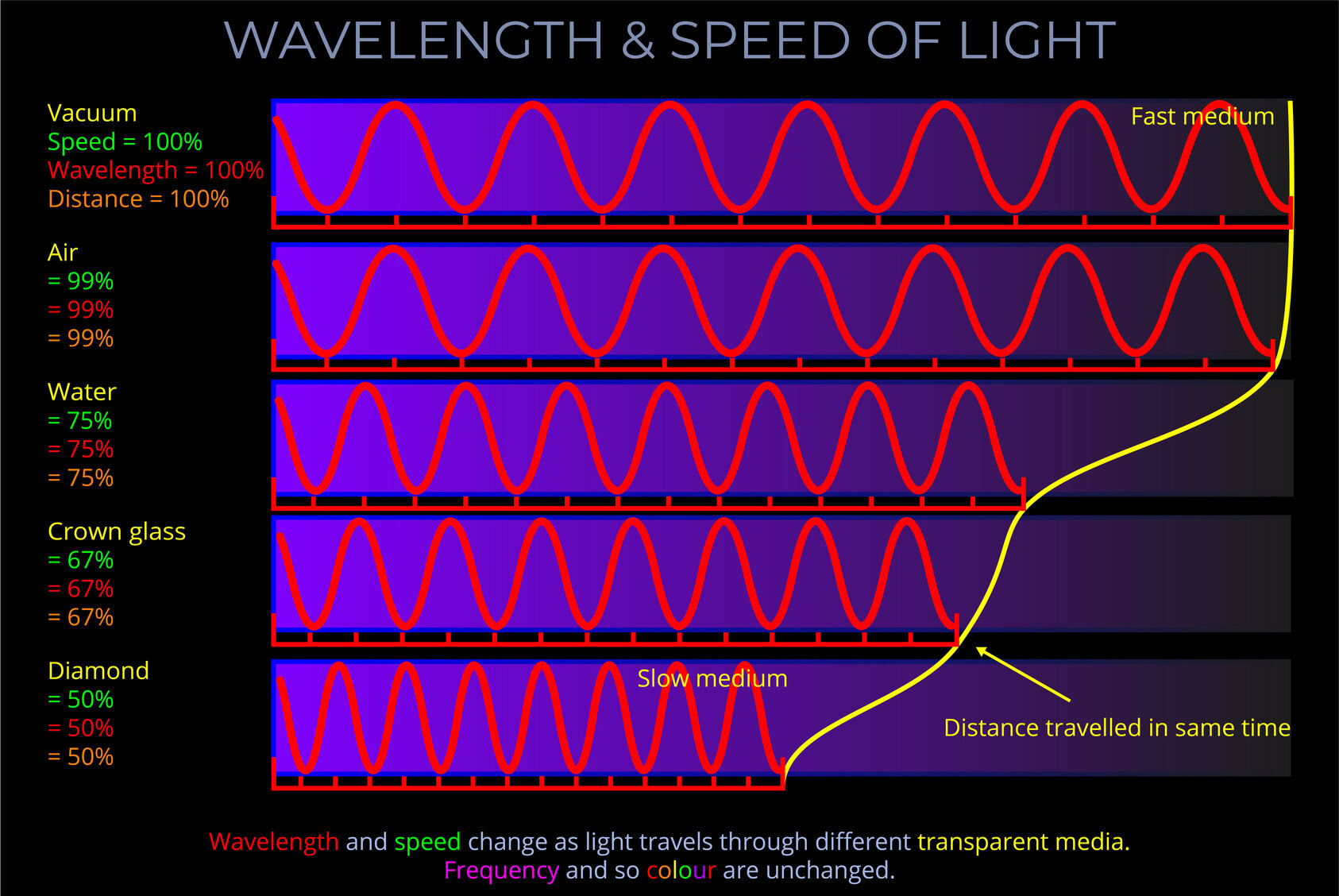
- Propagation of electromagnetic waves can occur in a vacuum as well as through different media. Other wave types such as sound waves cannot propagate through a vacuum and require a transmission medium.
- All forms of electromagnetic radiation propagate in similar ways whether they are radio waves, microwaves, infrared, (visible) light, ultraviolet, X-rays, or gamma rays.
Wave propagation is any of the ways in which waves pass through a vacuum or medium.
- Electromagnetic radiation propagates through space, carrying electromagnetic energy in the form of electromagnetic waves.
- The propagation of electromagnetic radiation through space is sometimes described in terms of photons rather than waves.
- Photons are particles that are sometimes used to explain the behaviour of electromagnetic waves.
- Propagation of electromagnetic waves can occur in a vacuum as well as through different media. Other wave types such as sound waves cannot propagate through a vacuum and require a transmission medium.
- All forms of electromagnetic radiation propagate in similar ways whether they are radio waves, microwaves, infrared, (visible) light, ultraviolet, X-rays or gamma rays.
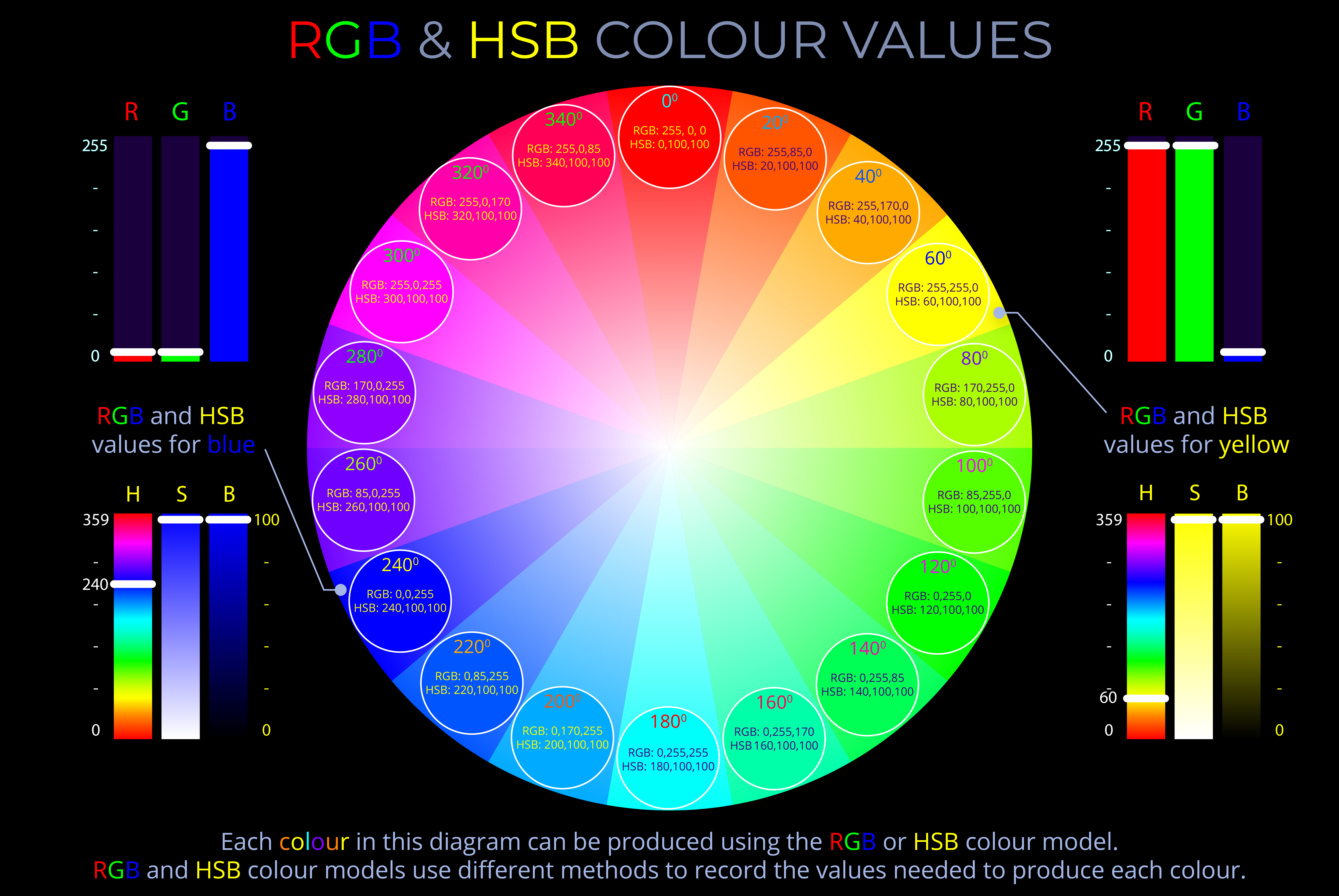
A pure colour is a monochromatic colour with no added tint or shade and can be produced by a single wavelength of light at full saturation.
- Any single wavelength of light at full saturation and brightness is perceived as a pure colour.
- Saturation refers to the purity or vividness of a colour, while brightness refers to the intensity or amount of light in a colour.
- Tint refers to a hue that has been mixed with white, while shade refers to a hue that has been mixed with black.
- A monochromatic colour on the other hand refers to a colour produced by a single wavelength of light but including all of its tints and shades.
- Colours produced by a narrow band of adjacent wavelengths may appear to be pure colours.
- Spectral colours are the hues that are produced by the separation of white light into its component colours by refraction or diffraction, as seen in a rainbow.
Qualitative refers to a description or analysis of something based on its qualities or attributes, rather than on measurable or quantitative data.
- Qualitative analysis in physics focuses on the inherent properties or characteristics of the thing being studied, rather than on numerical values or precise measurements.
- Qualitative analysis involves making observations, interpreting patterns and relationships, and drawing conclusions based on these observations, rather than relying solely on numerical data or statistical analysis.
- Qualitative analysis might involve making observations and drawing inferences about the behaviour of a system or object based on its properties, such as its shape, colour, texture, or motion.
Quantum Electrodynamics (QED) is a Quantum Field Theory that describes how electromagnetic interactions work at the quantum level. As a fundamental theory in physics, it specifically deals with the interactions between light (electromagnetic radiation) and matter.
- QED is an integral part of the Standard Model of particle physics, a theoretical framework that encompasses the fundamental particles and their interactions. It constitutes the electromagnetic sector of the Standard Model, working alongside the weak nuclear force and the strong nuclear force.
- As a quantum field theory, QED describes particle and field behaviour in terms of probabilities and wave functions by accounting for the principles of quantum mechanics that distinguish it from classical physics.
- QED’s primary focus is on the electromagnetic force, encompassing interactions involving charged particles (such as electrons and protons) and photons (particles of light).
- In QED, interactions between charged particles are described in terms of the exchange of virtual photons. These are not “real” photons in the sense that they cannot be observed directly but are theoretical mathematical constructs that represent the invisible intermediary particles in an interaction.
- QED calculations frequently employ Feynman diagrams, graphical representations of particle interactions that offer a visual means to comprehend and compute the probabilities of likely scenarios.
- In QED, electromagnetic fields are not considered fundamental entities. Instead, they emerge from the interactions of photons. It is photons, elementary particles of light, That serve as the carriers of the electromagnetic force and generate the electromagnetic fields.
Quantum fields are thought to be the underlying reality of all particles and forces. Quantum fields are the building blocks of the universe and play a crucial role in understanding the behaviour of elementary particles and their interactions.
- A quantum field is a physical field that can be described by a quantum operator. It is the fundamental entity that gives rise to elementary particles.
- The word “physical” in this context means that the field is a real entity not just a mathematical abstraction. For example, the electromagnetic field can be measured using a variety of devices, such as electric and magnetic field detectors.
- “Quantum operators” are used to represent physical observables sung variables to represent factors such as position, momentum, and energy.
- In the context of quantum field theory, quantum operators are used to describe the creation and annihilation of elementary particles. For example, the creation operator for the photon is a quantum operator that can be used to describe the quantum state of a new photon.
Quantum Field Theory (QFT) is a theoretical framework that combines classical field theory, special relativity, and quantum mechanics.
- Quantum fields are thought to be the underlying reality of all particles and forces. Quantum field theory has developed the Standard Model to describe all the known fundamental particles and force carriers as fields.
- Quantum field theory uses mathematical formulas to represent things that are often too small or transient to observe. The exact behaviour of forces, particles and waves can often only be inferred and so must be described in terms of a mathematical probability of different events and outcomes.
- Quantum fields serve as the comprehensive framework that encompasses the entirety of matter-energy and can be thought of as a dynamic medium that permeates all of space. It is a unified theory of spacetime and matter in which particles are simply localized excitations of this medium. This means that when a particle appears, it is a localized disturbance in a quantum field. When a particle is destroyed, the disturbance in the quantum field disappears.
- In quantum field theory, a quantum field is an entity whose fundamental element is a “quantum” of energy. A quantum of energy is the smallest possible unit quantity that can be contained within a field. This is the smallest possible unit that can be used to describe the behaviour of the quantum field in question.
- So, a quantum field can be thought of as a field that may be made up of a single quantum of vibrating matter-energy – a particle. However, a quantum field can include more than one unit. The number of particles in a quantum field is determined by the state of the field so can be between zero to an infinity of quanta.
- A field containing a single particle and a field containing groups of particles are related in the sense that they are both manifestations of the same underlying quantum field. The difference is that the field containing a single quantum is a localized disturbance, while the field containing groups of particles is more spread out (diffuse).
- The electromagnetic field (EM field) is an example of a quantum field. Disturbances in the EM field create photons. Photons are responsible for all forms of electromagnetic radiation from radio waves through visible light to gamma rays. It is also responsible for the force of electromagnetism, which is one of the four fundamental forces of nature.