- Matter is the substance that makes up all physical objects and substances in the universe, including solids, liquids, and gases.
- Matter is made up of atoms, which may combine to form molecules. Atoms in turn consist of subatomic particles such as protons, neutrons, and electrons.
- Subatomic particles have mass and may have energy.
- Matter can undergo physical and chemical changes, but the total amount of matter in a closed system remains constant (Law of Conservation of Matter). This means that matter cannot be created or destroyed in chemical reactions, only transformed into different forms.
- Light is a form of electromagnetic radiation, which does not have mass and is not considered matter.
- light interacts with matter (e.g., through absorption, reflection, and transmission), but is not composed of particles with mass.
- Einstein’s equation E=MC2 suggests that mass and energy are interchangeable and one can be converted to the other.
- Mass-energy equivalence means that mass can be converted into energy and vice versa, as demonstrated in nuclear reactions and particle interactions.
Dictionary tag: K-L-M-N-O
Matter
Matter is anything that has mass and energy and occupies space by virtue of having volume.
- Matter is the substance that makes up all physical objects and substances in the universe, including solids, liquids, and gases.
- Matter is made up of atoms, which may combine to form molecules. Atoms in turn consist of subatomic particles such as protons, neutrons, and electrons.
- Subatomic particles have mass and may have energy.
- Matter can undergo physical and chemical changes, but the total amount of matter in a closed system remains constant (Law of Conservation of Matter). This means that matter cannot be created or destroyed in chemical reactions, only transformed into different forms.
- Light is a form of electromagnetic radiation, which does not have mass and is not considered matter.
- light interacts with matter (e.g., through absorption, reflection, and transmission), but is not composed of particles with mass.
Medium
- Light is a form of electromagnetic radiation, which travels in the form of waves. These waves consist of oscillating electric and magnetic fields.
- The properties of the medium, such as its density and composition, influence how light propagates through it.
- Different mediums can affect the speed, direction, and behaviour of light waves. For instance, light travels slower in water compared to a vacuum.
- Examples of Mediums:
- Transparent: Materials like air, glass, and water allow most light to pass through, with minimal absorption or scattering. These are good examples of mediums for light propagation.
- Translucent: Some materials, like frosted glass or thin paper, partially transmit light. They allow some light to pass through while diffusing or scattering the rest.
- Opaque: Materials like wood or metal block light completely. They don’t allow any light to travel through them.
- The permittivity (electrical response) and permeability (magnetic response) of a medium determine how light interacts with it. These properties influence factors like:
- Refraction: Bending of light as it travels from one medium to another with different densities.
- Reflection: Bouncing back of light when it encounters a boundary between mediums.
- Absorption: Light being captured and converted into other forms of energy (like heat) by the medium.
Medium
In physics and optics, a medium refers to any material through which light or other electromagnetic waves can travel. It’s essentially a substance that acts as a carrier for these waves.
- Light is a form of electromagnetic radiation, which travels in the form of waves. These waves consist of oscillating electric and magnetic fields.
- The properties of the medium, such as its density and composition, influence how light propagates through it.
- Different mediums can affect the speed, direction, and behaviour of light waves. For instance, light travels slower in water compared to a vacuum.
- Examples of Mediums:
- Transparent: Materials like air, glass, and water allow most light to pass through, with minimal absorption or scattering. These are good examples of mediums for light propagation.
- Translucent: Some materials, like frosted glass or thin paper, partially transmit light. They allow some light to pass through while diffusing or scattering the rest.
- Opaque: Materials like wood or metal block light completely. They don’t allow any light to travel through them.
Metameric
The term metameric refers to visually indistinguishable colour stimuli that appear the same but have different spectral compositions are called metameric.
- Metameric stimuli are colour stimuli that are indistinguishable from one another because they produce the same responses from the three types of cone cells in the human eye that are responsible for colour vision.
- Metameric matches can occur in different parts of the spectrum, which means that the spectral power distributions of different light sources can look similar, but not identical, to one another.
- A class of metameric stimuli can be specified by a set of tristimulus values, which represent the amounts of three reference colours, typically red, green, and blue, in a given trichromatic system, that are required to match the colour of the stimulus considered.
- The most important application of metameric stimuli is in the use of tristimulus values for additive colour mixing, such as in computer displays and TVs.
- The RGB colour model, for example, uses mixtures of red, green, and blue light to produce a wide range of colours visible to an observer.
Metameric
The term metameric refers to visually indistinguishable colour stimuli that appear the same but have different spectral compositions are called metameric.
- Metameric stimuli are colour stimuli that are indistinguishable from one another because they produce the same responses from the three types of cone cells in the human eye that are responsible for colour vision.
- Metameric matches can occur in different parts of the spectrum, which means that the spectral power distributions of different light sources can look similar, but not identical, to one another.
- A class of metameric stimuli can be specified by a set of tristimulus values, which represent the amounts of three reference colours, typically red, green, and blue, in a given trichromatic system, that are required to match the colour of the stimulus considered.
- The most important application of metameric stimuli is in the use of tristimulus values for additive colour mixing, such as in computer displays and TVs.
- The RGB colour model, for example, uses mixtures of red, green, and blue light to produce a wide range of colours visible to an observer.
Microscopic images of the Sun
When an observer looks up into the sky and sees an atmospheric rainbow they are looking at tiny images of the Sun mirrored in millions of individual raindrops. This is what produces the impression of arching bands of colour.
- It is the mirror-like surfaces on the inside of raindrops that reflect microscopic images of the Sun towards an observer.
- The images are tiny because raindrops are small, but also because the surface they reflect off is concave.
- At a micro-scale, each image of the Sun is different:
- Each and every image is a different colour and depends on the wavelength of light each raindrop is reflecting towards an observer’s eyes at any particular moment.
- For convenience sake, wavelength is usually measured in nanometres, but nanometres can be divided into picometres (or even smaller units). This means that an observer is looking at countless wavelengths of light and so countless colours.
- The images range in size and shape depending on the dimensions of the droplets and turbulence in the atmosphere. The size and roundness of raindrops also affect the appearance of a rainbow as a whole.
- The millions of microscopic images of the Sun that produce the impression of a rainbow is similar to the way pixels of light produce the images we see on digital displays.
Notice that:
- If all the rays of incident light that contribute to the formation of an observer’s rainbow are traced back from each raindrop towards the Sun it transpires that they are produced by parallel rays and that each incident ray is polarized as it passes through a droplet.
- If all the rays of incident light that travel through a single raindrop as it falls are compared, it transpires that they are all parallel with the axis of the rainbow.
Minimum angle of deviation
The minimum angle of deviation of a ray of light of any specific wavelength passing through a raindrop is the smallest angle to which it must change course before it becomes visible within the arcs of a rainbow to an observer.
- Any ray of light (stream of photons) travelling through empty space, unaffected by gravitational forces, travels in a straight line forever.
- When light travels from a vacuum or from one transparent medium into another, it deviates from its original path (and changes speed).
- The more a ray changes direction the greater its angle of deviation.
- A ray reflected directly back on itself has an angle of deviation of 1800 – the maximum possible angle of deviation.
- It is the optical properties of air and raindrops that determines the angle of deviation of any ray of incident light.
- It is the optical properties of raindrops that prevent any ray of visible light within the visible spectrum from exiting a raindrop towards an observer at an angle of deviation less than 137.60.
- The angle of deviation and the angle of deflection are directly related to one another and together always add up to 1800.
- The angle of deviation and the viewing angle are always the same.
More about the minimum angle of deviation
- The optical properties of an idealised spherical raindrop mean that no light of any particular wavelength can deviate at less than its minimum angle of deviation.
- The minimum angle of deviation of visible light depends on its wavelength.
- The minimum angle of deviation for red light with a wavelength of approx. 720 nm is 137.60 but similar rays of the same wavelength but with other impact parameters can deviate up to a maximum of 1800.
- Different colours have different minimum angles of deviation because the refractive index of water changes with wavelength.
Impact parameter and minimum angle of deviation
- To form a primary rainbow, incident light must strike each raindrop above its horizontal axis.
- Rays of incident light of a single wavelength strike a raindrop at every possible point on the side of a raindrop facing the Sun.
- Only those that strike above the horizontal axis contribute to a primary rainbow.
- Points of impact of incident light striking a droplet can be measured on an impact parameter scale.
- It is the point of impact of rays of incident light of the same wavelength that is the variable factor that determines their subsequently different paths.
- Rays that strike nearest the horizontal axis, so with a value near 0.0 on an impact parameter scale have the largest angles of deviation.
- Rays that strike farthest away from the horizontal axis (near the topmost point on an impact parameter scale and so near 1.0) also have a large angle of deviation.
Momentum
- Momentum is a vector quantity, which means that it has both magnitude and direction.
- Momentum = mass x velocity.
- Momentum is conserved, which means that the total momentum of a system remains constant unless an external force acts on the system.
- Momentum can only be transferred between objects, not created or destroyed.
- Examples of momentum:
- A bowling ball has more momentum than a baseball because it has more mass.
- A car moving at 60 mph has more momentum than a car moving at 30 mph.
- A rocket launching into space has a lot of momentum because it has a lot of mass and it is moving very fast.
Momentum & photons
- Photons are massless particles, but they can still exert a force on other objects. This is because photons have momentum and can interact with matter through the electromagnetic force:
- Photons have no rest mass, but they do have momentum.
- Photons can interact with matter through their momentum.
- Photons can also interact with matter through the electromagnetic force.
- The interaction of photons with matter can be used to explain a variety of phenomena, such as reflection, refraction, and absorption.
- The fact that photons have momentum and can interact with matter through the electromagnetic force means that they can exert a force on other objects.
- Here are some other examples of how photons can exert a force on other objects:
- Radiation pressure: Radiation pressure is the pressure exerted by photons on a surface. It is responsible for the tails of comets, which point away from the sun.
- Light pressure: Light pressure is the force exerted by photons on a particle. It is used in optical tweezers to trap and manipulate small particles.
- Photoelectric effect: The photoelectric effect is the emission of electrons from a metal surface when it is illuminated by light. It is caused by the transfer of momentum from the photons to the electrons.
References
- 1
- 2
Momentum
Momentum is a measure of how much mass an object has and how fast it is moving. It is calculated by multiplying the mass of the object by its velocity.
- Momentum is a vector quantity, which means that it has both magnitude and direction.
- Momentum = mass x velocity.
- Momentum is conserved, which means that the total momentum of a system remains constant unless an external force acts on the system.
- Momentum can only be transferred between objects, not created or destroyed.
- Examples of momentum:
- A bowling ball has more momentum than a baseball because it has more mass.
- A car moving at 60 mph has more momentum than a car moving at 30 mph.
- A rocket launching into space has a lot of momentum because it has a lot of mass and it is moving very fast.
Monochromatic
Monochromatic refers to light or electromagnetic radiation that consists of a single wavelength or frequency. In simpler terms, monochromatic light is composed of just one colour. The term comes from the Greek words mono (meaning “one”) and chroma (meaning “colour”).
- Monochromatic colours are created by using variations of a single hue, incorporating both shades (by adding black) and tints (by adding white). For example, a monochromatic colour scheme could involve a range of blues or pinks.
- It’s important not to confuse monochrome with greyscale. Monochrome refers to variations of a single hue, which can include any colour. In contrast, greyscale consists solely of shades of grey, with no colour information.
- In physics, monochromatic light refers to visible light or other electromagnetic radiation that has a single wavelength or frequency, resulting in light of a single colour.
- A surface or material is considered monochromatic if it features only one hue or a combination of tints and shades of the same colour.
Related diagrams
Each diagram below can be viewed on its own page with a full explanation.
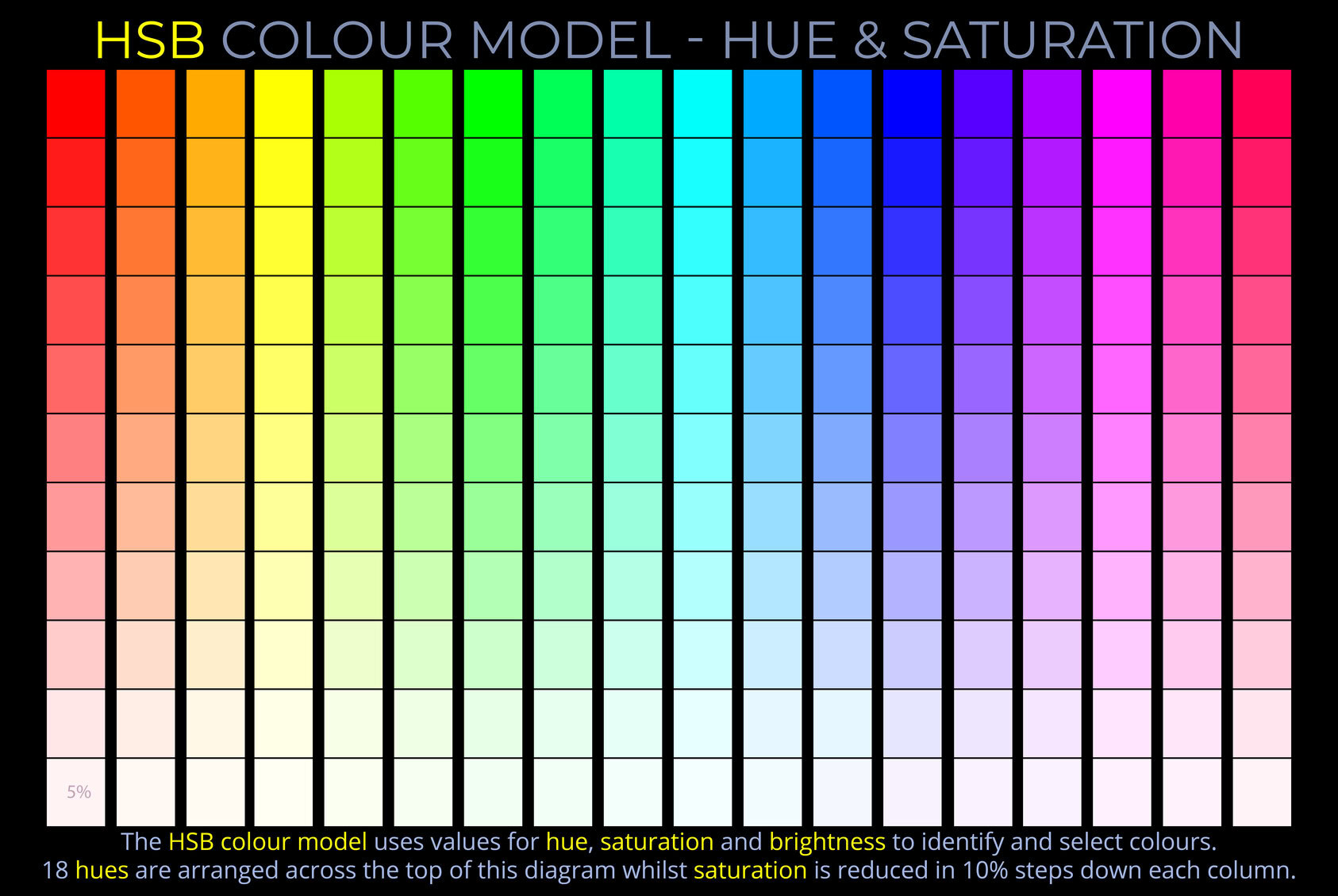
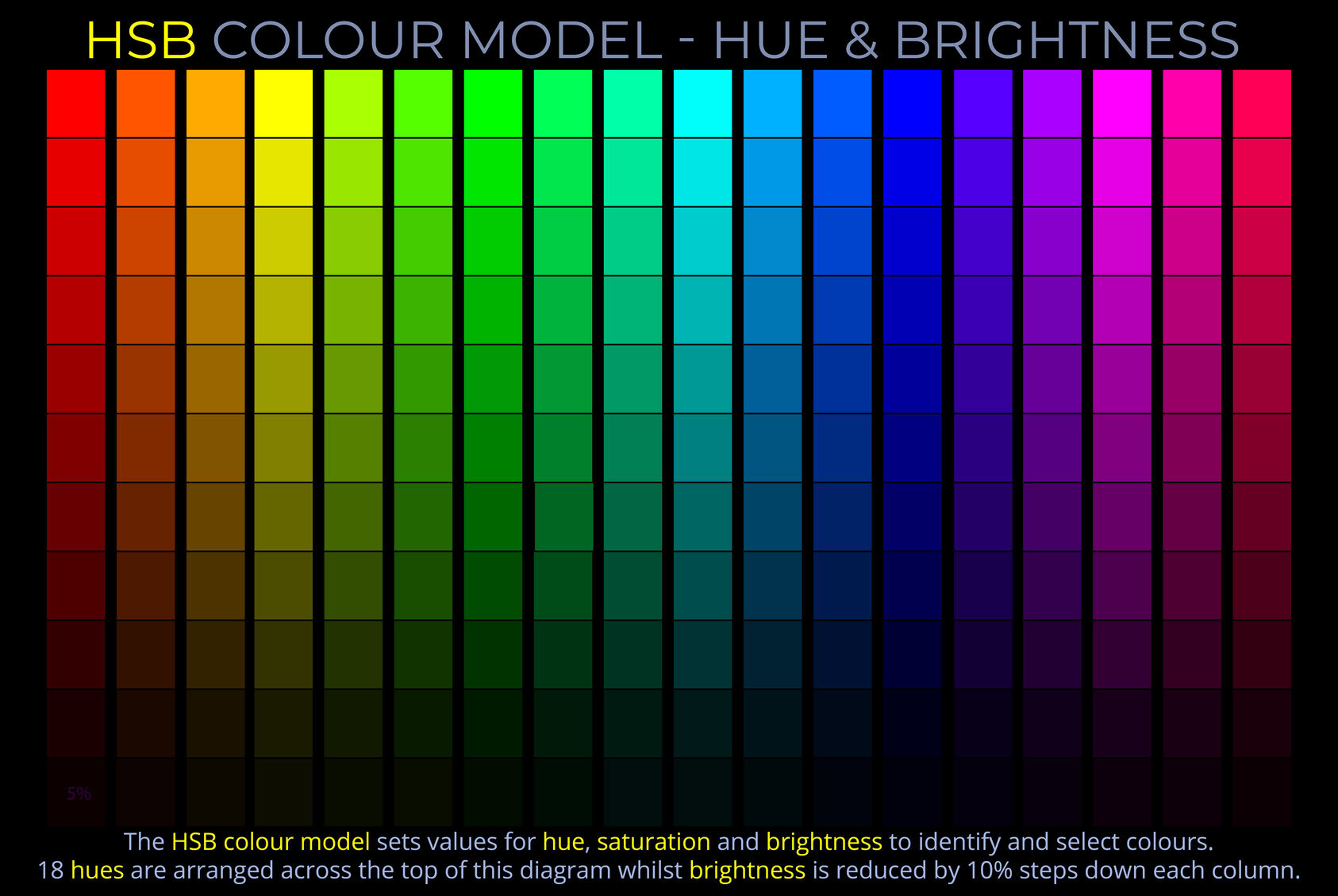
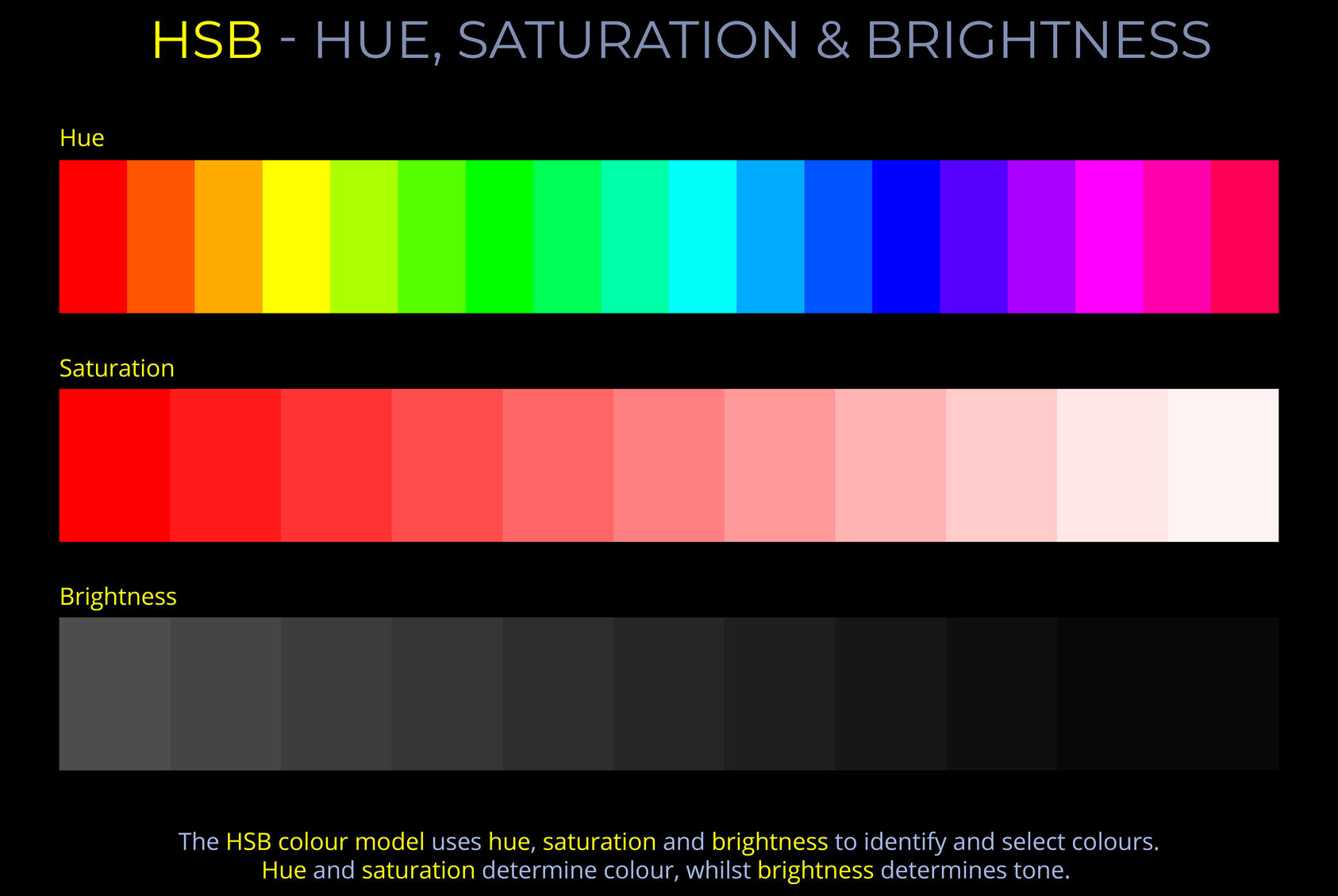

Monochromatic
Monochromatic refers to light or electromagnetic radiation that consists of a single wavelength or frequency. In simpler terms, monochromatic light is composed of just one colour. The term comes from the Greek words mono (meaning “one”) and chroma (meaning “colour”).
- Monochromatic colours are created by using variations of a single hue, incorporating both shades (by adding black) and tints (by adding white). For example, a monochromatic colour scheme could involve a range of blues or pinks.
- It’s important not to confuse monochrome with greyscale. Monochrome refers to variations of a single hue, which can include any colour. In contrast, greyscale consists solely of shades of grey, with no colour information.
- In physics, monochromatic light refers to visible light or other electromagnetic radiation that has a single wavelength or frequency, resulting in light of a single colour.
- A surface or material is considered monochromatic if it features only one hue or a combination of tints and shades of the same colour.
Müller cell
Müller glia, or Müller cells, are a type of retinal glial cells in the human eye that serve as support cells for the neurons, as other glial cells do.
- An important role of Müller cells is to funnel light to the rod and cone photoreceptors from the outer surface of the retina to where the photoreceptors are located.
- Other functions include maintaining the structural and functional stability of retinal cells. They regulate the extracellular environment, remove debris, provide electrical insulation of receptors and other neurons, and mechanical support of the neural retina.
- All glial cells (or simply glia), are non-neuronal cells in the central nervous system (brain and spinal cord) and the peripheral nervous system.
- Müller cells are the most common type of glial cell found in the retina. While their cell bodies are located in the inner nuclear layer of the retina, they span the entire retina.
References
Müller cells
Müller cells
Müller glia, or Müller cells, are a type of retinal cell that serve as support cells for neurons, as other types of glial cells do.
An important role of Müller cells is to funnel light to the rod and cone photoreceptors from the outer surface of the retina to where the photoreceptors are located.
Other functions include maintaining the structural and functional stability of retinal cells. They regulate the extracellular environment, remove debris, provide electrical insulation of the photoreceptors and other neurons, and mechanical support for the fabric of the retina.
- All glial cells (or simply glia), are non-neuronal cells in the central nervous system (brain and spinal cord) and the peripheral nervous system.
- Müller cells are the most common type of glial cell found in the retina. While their cell bodies are located in the inner nuclear layer of the retina, they span the entire retina.
Müller cells
Müller glia, or Müller cells, are a type of retinal glial cells in the human eye that serve as support cells for the neurons, as other glial cells do.
- An important role of Müller cells is to funnel light to the rod and cone photoreceptors from the outer surface of the retina to where the photoreceptors are located.
- Other functions include maintaining the structural and functional stability of retinal cells. They regulate the extracellular environment, remove debris, provide electrical insulation of receptors and other neurons, and mechanical support of the neural retina.
- All glial cells (or simply glia), are non-neuronal cells in the central nervous system (brain and spinal cord) and the peripheral nervous system.
- Müller cells are the most common type of glial cell found in the retina. While their cell bodies are located in the inner nuclear layer of the retina, they span the entire retina.
Nanometre
A nanometre (nm) is a unit of length in the metric system, equal to one billionth of a metre (1 nm = 1 × 10⁻⁹ metres). It is commonly used to measure extremely small distances, particularly at the atomic and molecular scale.
- In the context of light and electromagnetic radiation, a nanometre is often used to describe wavelengths of visible light.
The wavelength of visible light ranges from about 700 nm (red) to 400 nm (violet). - Nanometres are also used to measure components like the thickness of materials, the size of particles in nanotechnology, and the spacing between atoms in a crystal lattice.
Natural light
A natural light source refers to any source of light that occurs in nature and is not created by human activity.
- The Sun is the most prominent and important natural light source on Earth, providing sunlight that powers life, such as through photosynthesis in plants.
- Stars emit light naturally due to nuclear reactions in their cores, which generate massive amounts of energy released as light.
- Fire can occur naturally through processes like lightning strikes igniting dry vegetation or volcanic activity.
- Bioluminescence is the natural emission of light by living organisms such as fireflies, some fungi, and deep-sea creatures.
- Auroras (like the Northern and Southern Lights) are natural light displays in the Earth’s atmosphere, caused by the interaction of solar wind with the Earth’s magnetic field.
- Lightning is another natural light source, produced during electrical storms when electrical charges in clouds discharge.
- Natural light sources vary in brightness, spectrum, and duration.
Natural light source
A natural light source is any source of light that occurs in nature without human intervention or creation. These sources can be celestial objects, atmospheric phenomena, or living organisms.
Celestial Objects
- The Sun: Our primary source of natural light, providing warmth, driving photosynthesis, and allowing us to see.
- Other Stars: Distant stars are inherently sources of light, though they appear far less bright to us due to their vast distances.
- The Moon: It doesn’t produce its own light but reflects sunlight, providing a source of natural illumination at night.
Atmospheric Phenomena
- Lightning: Electrical discharges in the atmosphere create bright flashes of natural light.
- Auroras (Borealis and Australis): Caused by charged particles from the sun interacting with the Earth’s magnetic field, creating vibrant displays of light in the sky.
Living Organisms (Bioluminescence)
- Fireflies: Use chemical reactions to generate light for attracting mates or prey.
- Jellyfish: Some species emit light as a defence mechanism or method of communication.
- Deep-sea creatures: Many creatures in the depths of the ocean produce light to navigate, lure prey, or find mates in a completely dark environment.
Key Points about Natural Light
- Essential: Natural light is crucial for life on Earth, influencing plant growth, animal behaviour, and even human well-being.
- Spectrum: Natural light sources often emit a broad spectrum of wavelengths, including colours visible to the human eye.
- Unpredictable (sometimes): The availability and intensity of some natural light sources can be affected by factors such as weather, time of day, or season.
| Light sources | Emission mechanism | Description | Examples |
|---|---|---|---|
| LIGHT-EMITTING PROCESS | |||
| Luminescence | Light emission due to the excitation of electrons in a material. | Electrons within a material gain energy and then release light as they return to a lower energy state. | Bioelectroluminescence Electroluminescence Photoluminescence - Fluorescence - Phosphorescence Sonoluminescence Thermoluminescence |
| Blackbody radiation (Type of thermal radiation) | Electromagnetic radiation (including visible light) emitted by any object with a temperature above absolute zero. | Electromagnetic radiation (including visible light) emitted by any object with a temperature above absolute zero. | All objects above temperature of absolute zero. |
| Chemiluminescence | Light from natural and artificial chemical reactions. | Light from natural and artificial chemical reactions. | Bioluminescence Chemiluminescent reactions: - Luminol reactions - Ruthenium chemiluminescence |
| Nuclear reaction | Light emission as a byproduct of nuclear reactions (fusion or fission). | Light emitted as a byproduct of nuclear reactions. | Nuclear reactors Stars undergoing fusion |
| Thermal radiation | Light emission due to the thermal excitation of atoms and molecules at high temperatures. | Light emission due to the thermal excitation of atoms and molecules. | Sun Stars Incandescent light bulbs |
| Triboluminescence | Light emission due to mechanical stress applied to a material. | Light emission due to the mechanical stress applied to a material, causing the movement of electric charges and subsequent light emission. | Sugar crystals cracking Adhesive tape peeling Quartz crystals fracturing. |
| Natural light source | |||
| Fireflies Deep-sea creatures Glowing mushrooms | Bioluminescence | Light emission from biological organisms. | Involves the luciferase enzyme. |
| Sun Stars | Nuclear Fusion | Light emission as a byproduct of nuclear fusion reactions in stars. | Electromagnetic spectrum (visible light, infrared, ultraviolet). |
| Fire Candles | Thermal radiation | Light emission due to the thermal excitation of atoms and molecules during the combustion of a fuel source. | Burning of a fuel source, releasing heat and light. |
| Artificial light source | |||
| Fluorescent lights Highlighters Safety vests | Chemiluminescence | Light emission from chemical reactions. | Fluorescence (absorption and re-emission of light). |
| Glow sticks Emergency signs | Chemiluminescence | Light emission due to phosphorescence - a type of chemiluminescence. | A type of chemiluminescence where light emission is delayed after the initial excitation. |
| Glow sticks Light sticks | Chemiluminescence | Chemiluminescence | Light emission from a chemical reaction that does not involve combustion. |
| Tungsten light bulbs Toasters | Thermal radiation | Heated filament radiates light and heat. | Light emission from a hot filament. |
| Fluorescent lamps LED lights | Electroluminescence | Excitation of atoms by electric current. | Light emission when electric current excites atoms in a material. |
| Neon signs | Electrical Discharge | Discharge of electricity through gas. | Light emission when electricity flows through a gas. |
| Sugar crystals cracking Pressure-sensitive adhesives | Triboluminescence | Light emission from friction or pressure. | Light emission due to mechanical forces. |
| Fluorescent paint Highlighters Safety vests | Photoluminescence | Absorption and subsequent re-emission of light at a lower energy. | Absorption and re-emission of light. |
Light Sources: Mechanism, examples, and everyday applications
Footnote: Cerenkov radiation and Synchrotron radiation are not included in the table because they are not conventionally classified as light sources.
Nature
Nature, in the broad sense, refers to the physical universe encompassing all living organisms (plants, animals, microorganisms) and non-living entities (such as rocks, water, and atmospheric elements). It includes the natural processes and forces that govern the physical world, as well as ecosystems and the interactions between living and non-living components.
- Nature, in the broadest sense, refers to the physical universe, encompassing all living and non-living things.
- In a more limited sense, nature can refer specifically to interconnected living organisms, including plants, insects, and animals, while sometimes excluding non-living elements like oceans, continents, and climate.
- However, it’s important to note that non-living phenomena are also an essential part of nature, as they play a vital role in ecosystems and the natural processes that sustain life.
- The concept of nature is complex and multifaceted. For instance, while humans are part of nature, human-made environments such as cities, agriculture, and industries are often viewed as distinct from other natural phenomena.
References
Nature
Nature, in the broad sense, refers to the physical universe encompassing all living organisms (plants, animals, microorganisms) and non-living entities (such as rocks, water, and atmospheric elements). It includes the natural processes and forces that govern the physical world, as well as ecosystems and the interactions between living and non-living components.
- Nature, in the broadest sense, refers to the physical universe, encompassing all living and non-living things.
- In a more limited sense, nature can refer specifically to interconnected living organisms, including plants, insects, and animals, while sometimes excluding non-living elements like oceans, continents, and climate.
- However, it’s important to note that non-living phenomena are also an essential part of nature, as they play a vital role in ecosystems and the natural processes that sustain life.
- The concept of nature is complex and multifaceted. For instance, while humans are part of nature, human-made environments such as cities, agriculture, and industries are often viewed as distinct from other natural phenomena.