Observed Colour of Raindrops
£0.00
This is one of a set of almost 40 diagrams exploring Rainbows.
Each diagram appears on a separate page and is supported by a full explanation.
- Follow the links embedded in the text for definitions of all the key terms.
- For quick reference don’t miss the summaries of key terms further down each page.
Description
Observed Colour of Raindrops
TRY SOME QUICK QUESTIONS AND ANSWERS TO GET STARTED
About the diagram
Overview of raindrops
About geometric raindrops
Some key terms
Incident light refers to light that is travelling towards an object or medium.
- Incident light refers to light that is travelling towards an object or medium.
- Incident light may come from the Sun, an artificial source or may have already been reflected off another surface, such as a mirror.
- When incident light strikes a surface or object, it may be absorbed, reflected, refracted, transmitted or undergo any combination of these optical effects.
- Incident light is typically represented on a ray diagram as a straight line with an arrow to indicate its direction of propagation.
Reflection is the process where light rebounds from a surface into the medium it came from, instead of being absorbed by an opaque material or transmitted through a transparent one.
- The three laws of reflection are as follows:
- When light hits a reflective surface, the incoming light, the reflected light, and an imaginary line perpendicular to the surface (called the “normal line”) are all in the same flat area.
- The angle between the incoming light and the normal line is the same as the angle between the reflected light and the normal line. In other words, light bounces off the surface at the same angle as it came in.
- The incoming and reflected light are mirror images of each other when looking along the normal line. If you were to fold the flat area along the normal line, the incoming light would line up with the reflected light.
- The observer effect is a principle of physics and states that any interaction between a particle and a measuring device will inevitably change the state of the particle. This is because the act of measurement itself imposes a disturbance on the particle’s wave function, which is the mathematical description of its state.
- The concept of observation refers to the act of engaging with an electron or other particle, achieved through measuring its position or momentum.
- In the context of quantum mechanics, observation isn’t a passive undertaking, observation actively alters a particle’s state.
- This means that any kind of interaction with an atom, or with one of its constituent particles, that provides insight into its state results in a change to that state. The act of observation is always intrusive and will always change the state of the object being observed.
- It can be challenging to reconcile this with our daily experience, where we believe we can observe things without inducing any change in them.
Internal reflection occurs when light travelling through a medium, such as water or glass, reaches the boundary with another medium, like air, and a portion of the light reflects back into the original medium. This happens regardless of the angle of incidence, as long as the light encounters the boundary between the two media.
- Internal reflection is a common phenomenon not only for visible light but for all types of electromagnetic radiation. For internal reflection to occur, the refractive index of the second medium must be lower than that of the first medium. This means internal reflection happens when light moves from a denser medium, such as water or glass, to a less dense medium, like air, but not when light moves from air to glass or water.
- In everyday situations, light is typically both refracted and reflected at the boundary between water or glass and air, often due to irregularities on the surface. If the angle at which light strikes this boundary is less than the critical angle, the light is refracted as it crosses into the second medium.
- When light strikes the boundary exactly at the critical angle, it neither fully reflects nor refracts but travels along the boundary between the two media. However, if the angle of incidence exceeds the critical angle, the light will undergo total internal reflection, meaning no light passes through, and all of it is reflected back into the original medium.
- The critical angle is the specific angle of incidence, measured with respect to the normal (a line perpendicular to the boundary), above which total internal reflection occurs.
- In ray diagrams, the normal is an imaginary line drawn perpendicular to the boundary between two media, and the angle of refraction is measured between the refracted ray and the normal. If the boundary is curved, the normal is drawn perpendicular to the curve at the point of incidence.
Refraction refers to the way that electromagnetic radiation (light) changes speed and direction as it travels across the boundary between one transparent medium and another.
- Light bends towards the normal and slows down when it moves from a fast medium (like air) to a slower medium (like water).
- Light bends away from the normal and speeds up when it moves from a slow medium (like diamond) to a faster medium (like glass).
- These phenomena are governed by Snell’s law, which describes the relationship between the angles of incidence and refraction.
- The refractive index (index of refraction) of a medium indicates how much the speed and direction of light are altered when travelling in or out of a medium.
- It is calculated by dividing the speed of light in a vacuum by the speed of light in the material.
- Snell’s law relates the angles of incidence and refraction to the refractive indices of the two media involved.
- Snell’s law states that the ratio of the sine of the angle of incidence to the sine of the angle of refraction is equal to the ratio of the refractive indices.
When discussing rainbows, angular distance is the angle between the line from the observer to the centre of the rainbow (rainbow axis) and the line from the observer to a specific colour within the arc of a rainbow.
- See this diagram for an explanation: Angular distance & Raindrop colour
- Angular distance is one of the angles measured on a ray-tracing diagram that illustrates the sun, an observer, and a rainbow from a side view.
- Think of angular distance as the angle between the line to the centre of a rainbow down which an observer looks and the line to a specific colour in its arc. The red light is deviated by about 42.4° and violet light by about 40.7°.
Total internal reflection occurs when light travelling through a denser medium strikes a boundary with a less dense medium at an angle exceeding a specific critical angle. As a result, all the light is reflected back into the denser medium, and no light transmits into the second medium.
- Total Internal reflection only takes place when the first medium (where the light originates) is denser than the second medium.
- The critical angle is the angle of incidence above which total internal reflection occurs.
- The critical angle is measured with respect to the normal.
- The normal is an imaginary line drawn in a ray diagram perpendicular to, so at a right angle to (900), to the boundary between two media.
A human observer is a person who engages in observation by watching things.
- In the presence of visible light, an observer perceives colour because the retina at the back of the human eye is sensitive to wavelengths of light that fall within the visible part of the electromagnetic spectrum.
- The visual experience of colour is associated with words such as red, blue, yellow, etc.
- The retina’s response to visible light can be described in terms of wavelength, frequency and brightness.
- Other properties of the world around us must be inferred from light patterns.
- An observation can take many forms such as:
- Watching an ocean sunset or the sky at night.
- Studying a baby’s face.
- Exploring something that can’t be seen by collecting data from an instrument or machine.
- Experimenting in a laboratory setting.
On a sunny day, if you stand with the Sun at your back and look at the ground, the shadow of your head will align with the antisolar point.
- The antisolar point is the position directly opposite the Sun, around which the arcs of a rainbow appear. An imaginary straight line can always be drawn that passes through the Sun, the eyes of an observer, and the antisolar point, which is the geometric centre of a rainbow.
- This concept corresponds with what an observer sees in real life: the idea that a rainbow has a center. From a side view, the centre of a rainbow is called the antisolar point, so named because it is opposite the Sun relative to the observer’s position.
- Unless observed from the air, the antisolar point is always below the horizon. Both primary and secondary rainbows share the same antisolar point, as do higher-order bows, such as fifth and sixth-order rainbows.
In the field of optics, diffusion refers to situations that cause parallel rays of light to spread out more widely. When light undergoes diffusion it becomes less concentrated. Diffuse reflections occur when light scatters off rough or irregular surfaces.
- When microscopic features on a surface are significantly larger than the individual wavelengths of light within the visible spectrum, each wavelength of light encounters bumps and ridges exceeding their size.
- Instead of reflecting neatly in one direction, the light scatters in different directions.
- In this case, scattering doesn’t happen completely randomly. The surface features influence the direction of the scattered light, depending on the angle of incidence and the specific bumps and ridges it encounters.
- This scattering creates diffuse reflections, responsible for the soft, uniform illumination seen on textured surfaces like matte paint or unpolished wood.
- In the case of a matte phone screen, for example, the light doesn’t form a clear reflection of your face but rather creates a soft, hazy glow due to the diffused light.
Diagrams are free to download
Related products
-

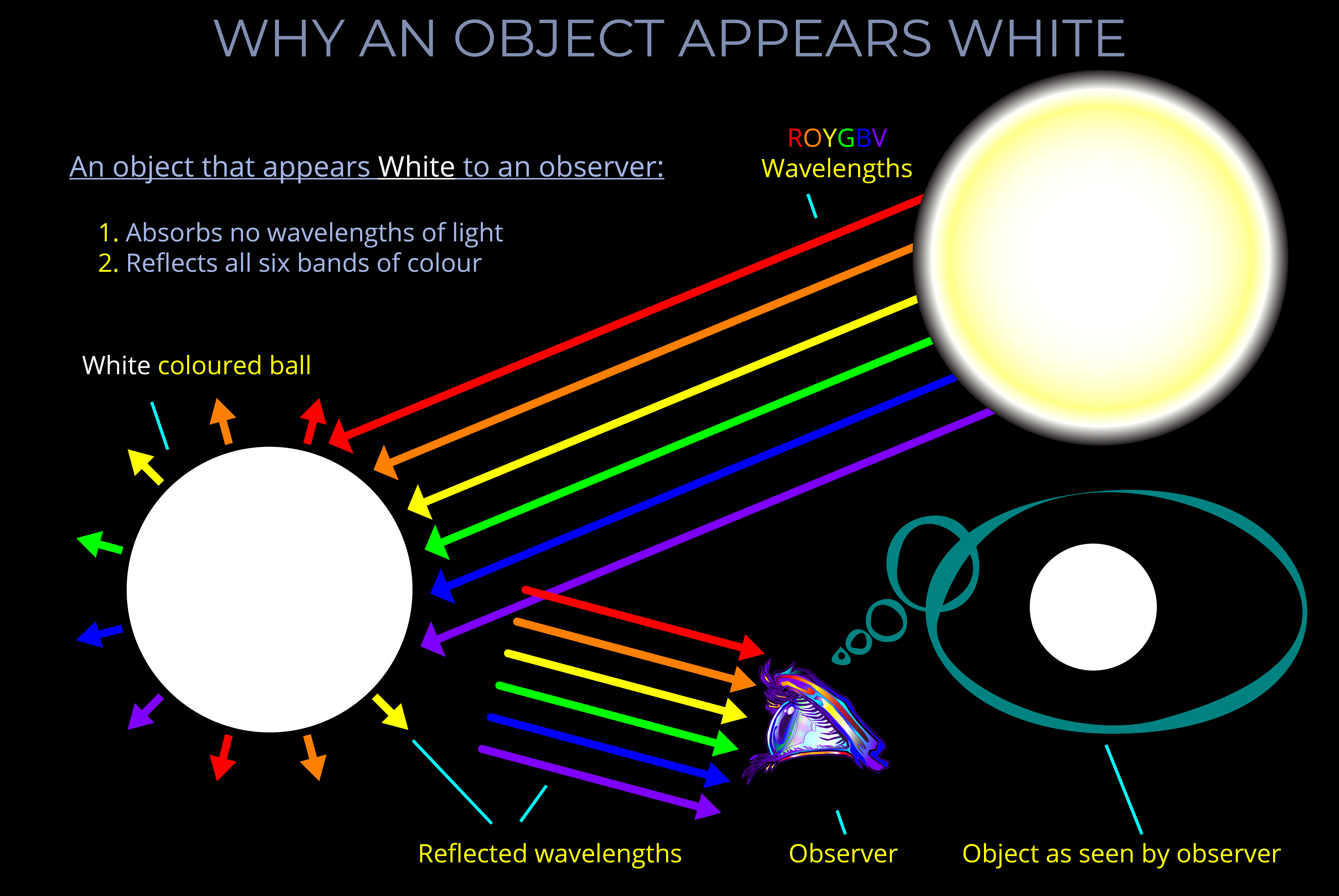
Why an Object Appears White
£0.00 Select options This product has multiple variants. The options may be chosen on the product page -
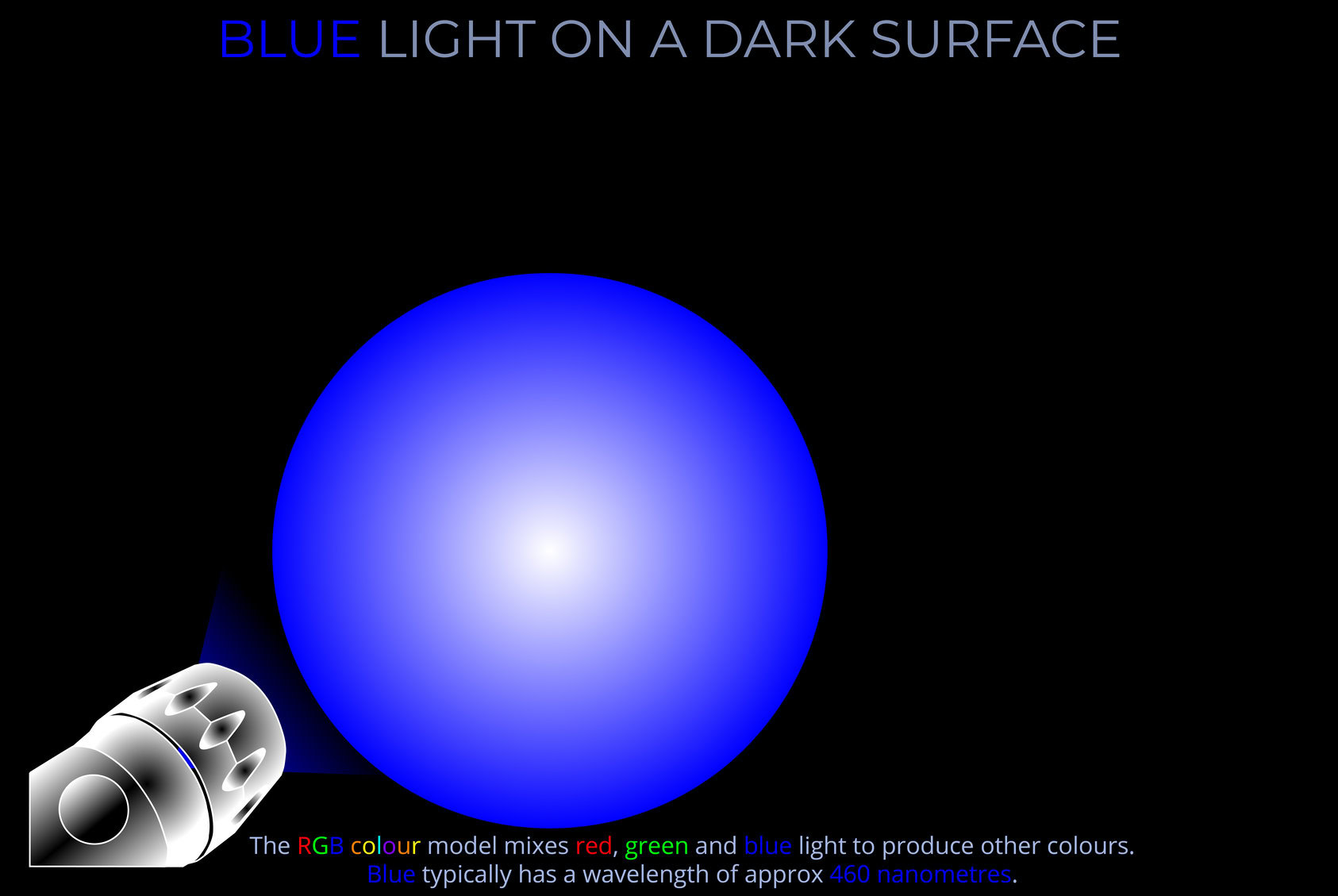
Blue Light on a Dark Surface
£0.00 Select options This product has multiple variants. The options may be chosen on the product page -
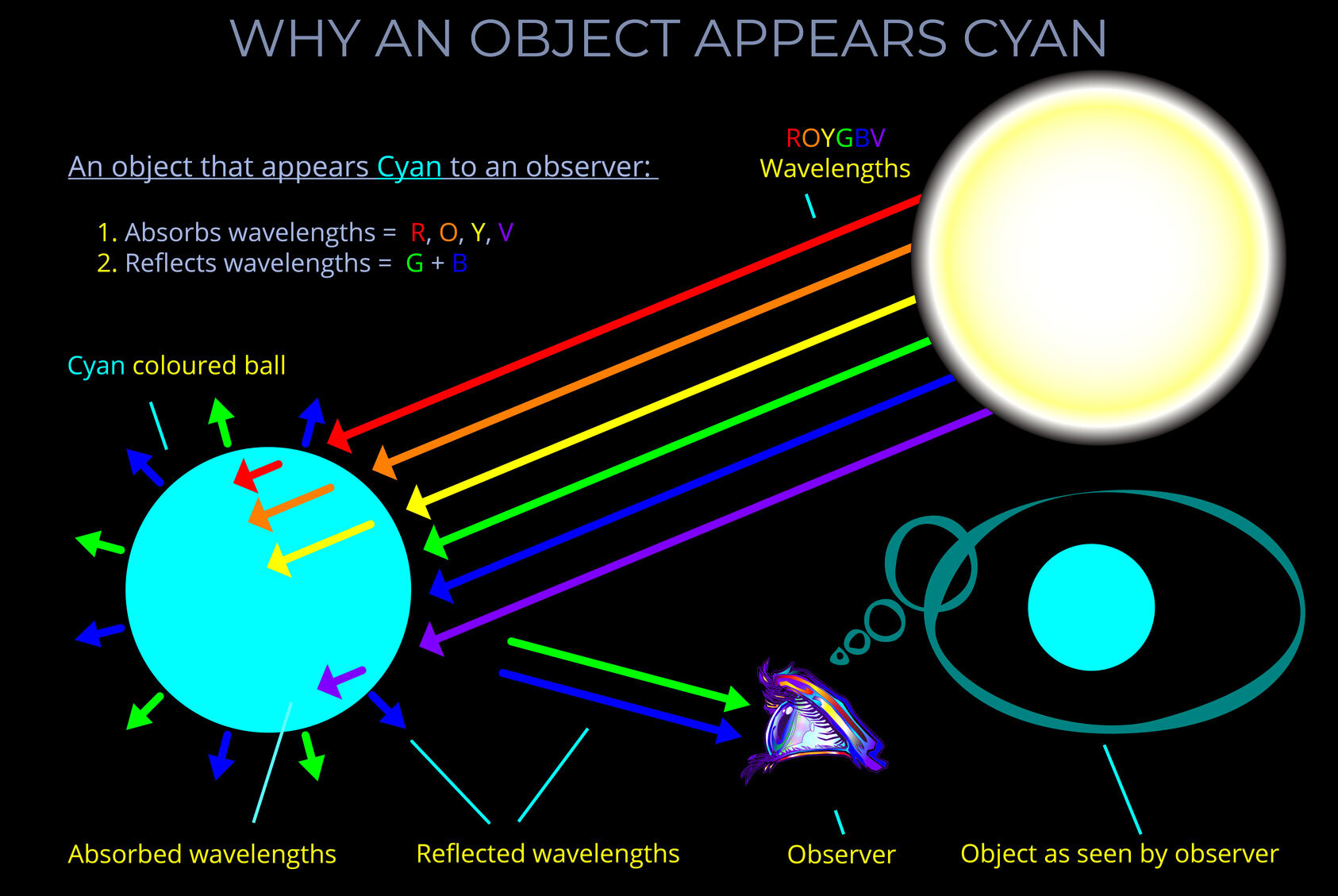
Why an Object Appears Cyan
£0.00 Select options This product has multiple variants. The options may be chosen on the product page