Wavelength & the EM Spectrum
$0.00
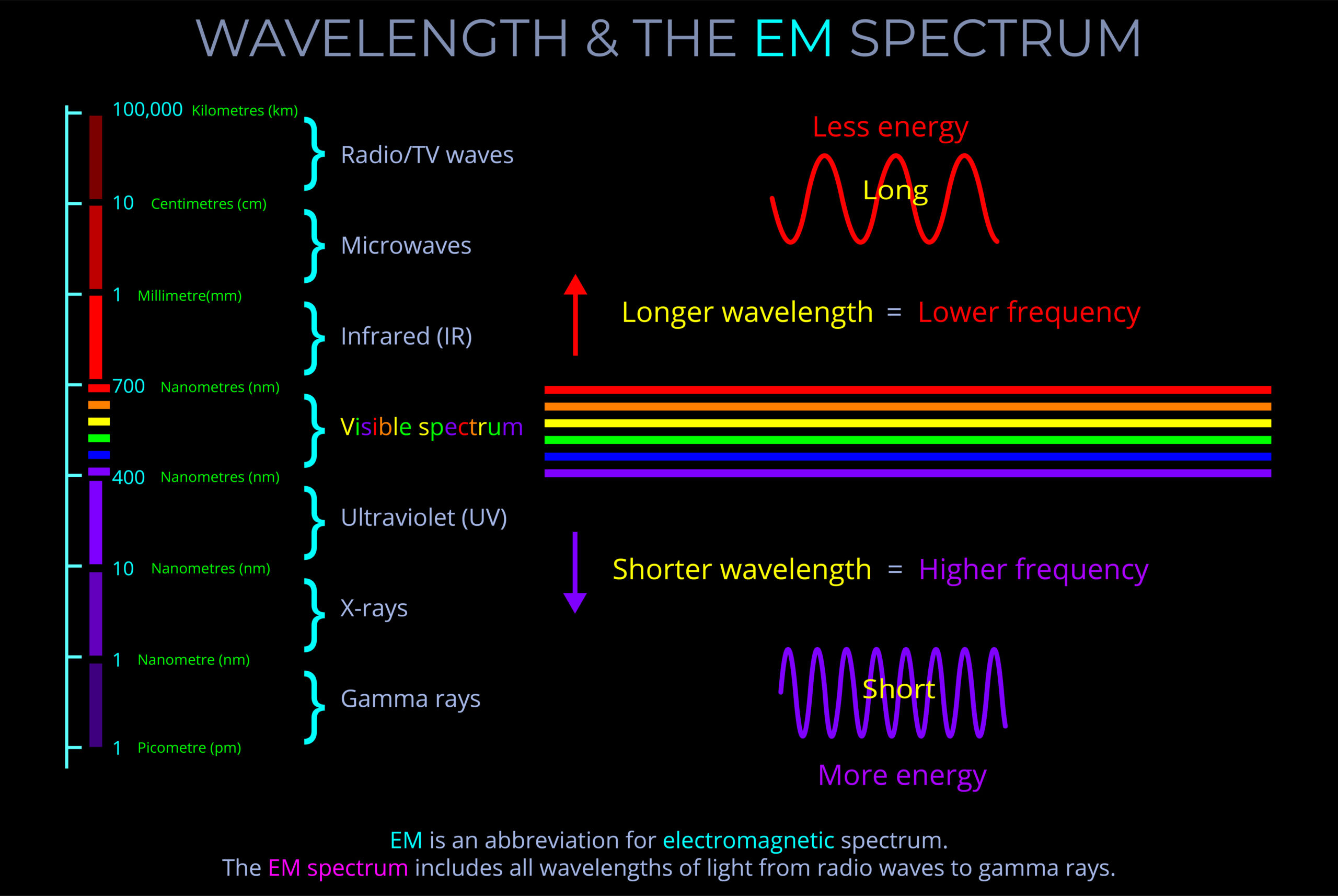
This diagram shows that the electromagnetic spectrum includes waves with all possible wavelengths of radiation.
Notice that:
- Wavelengths range from low energy radio waves through visible light to high energy gamma rays.
- Waves with longer wavelengths have a lower frequency and carry less energy.
- Waves with shorter wavelengths have a higher frequency and carry more energy.
Remember that:
- The electromagnetic spectrum includes, in order of increasing frequency and decreasing wavelength: radio waves, microwaves, infrared radiation, visible light, ultraviolet radiation, X-rays and gamma rays.
- There are no precisely defined boundaries between the bands of electromagnetic radiation in the electromagnetic spectrum.
Description
Wavelength & the EM Spectrum
TRY SOME QUICK QUESTIONS AND ANSWERS TO GET STARTED
About the diagram
About the diagram
- This diagram shows that the electromagnetic spectrum includes waves with all possible wavelengths of radiation.
Notice that:
- Wavelengths range from low energy radio waves through visible light to high energy gamma rays.
- Waves with longer wavelengths have a lower frequency and carry less energy.
- Waves with shorter wavelengths have a higher frequency and carry more energy.
Remember that:
- The electromagnetic spectrum includes, in order of increasing frequency and decreasing wavelength: radio waves, microwaves, infrared radiation, visible light, ultraviolet radiation, X-rays and gamma rays.
- There are no precisely defined boundaries between the bands of electromagnetic radiation in the electromagnetic spectrum.
- Visible light is only a very small part of the electromagnetic spectrum.
- Energy (electromagnetic energy) is the radiant energy (light) transported by electromagnetic waves.
- The term light can be used in three different ways:
- Light can be used to mean the whole of the electromagnetic spectrum from radio waves, through visible light to gamma rays. A better term is radiant energy or photon energy.
- Light can be used to mean the range of wavelengths and frequencies that can be detected by the human eye. A better term is visible light which refers to the wavelengths that correspond with the colours between red and violet, the visible spectrum.
- Light can be used to mean the range of wavelengths and frequencies between infra-red and ultra-violet. This usage is useful because the outer limits of the visible spectrum change under different lighting conditions and for different individuals.
- Referring to visible light simply as light is short-hand.
- Visible light is not the same for all living things.
Some key terms
The frequency of electromagnetic radiation (light) refers to the number of wave-cycles of an electromagnetic wave that pass a given point in a given amount of time.
An electromagnetic wave carries electromagnetic radiation.
- An electromagnetic wave is formed as electromagnetic radiation propagates from a light source, travels through space and encounters different materials.
- Electromagnetic waves can be imagined as synchronised oscillations of electric and magnetic fields that propagate at the speed of light in a vacuum.
- Electromagnetic waves are similar to other types of waves in so far as they can be measured in terms of wavelength, frequency and amplitude.
- We can feel electromagnetic waves release their energy when sunlight warms our skin.
- Remember that electromagnetic radiation can be described either as an oscillating wave or as a stream of particles, called photons, which also travel in a wave-like pattern.
- The notion of waves is often used to describe phenomena such as refraction or reflection whilst the particle analogy is used when dealing with phenomena such as diffraction and interference.
Wavelength is a measurement from any point on the path of a wave to the same point on its next oscillation. The measurement is made parallel to the centre-line of the wave.
- The wavelength of an electromagnetic wave is measured in metres.
- Each type of electromagnetic radiation, such as radio waves, visible light and gamma waves, forms a band of wavelengths on the electromagnetic spectrum.
- The visible part of the electromagnetic spectrum is composed of the range of wavelengths that correspond with all the different colours we see in the world.
- Human beings don’t see wavelengths of visible light, but they do see the spectral colours that correspond with each wavelength and the other colours produced when different wavelengths are combined.
- The wavelength of visible light is measured in nanometres. There are 1,000,000,000 nanometres to a metre.
The visible part of the electromagnetic spectrum is called the visible spectrum.
- The visible spectrum is the range of wavelengths of the electromagnetic spectrum that correspond with all the different colours we see in the world.
- As light travels through the air it is invisible to our eyes.
- Human beings don’t see wavelengths of light, but they do see the spectral colours that correspond with each wavelength and colours produced when different wavelengths are combined.
- The visible spectrum includes all the spectral colours between red and violet and each is produced by a single wavelength.
- The visible spectrum is often divided into named colours, though any division of this kind is somewhat arbitrary.
- Traditional colours referred to in English include red, orange, yellow, green, blue, and violet.
Energy is a property of matter.
- Everything contains energy including all forms of matter and so all objects.
- Energy is evident in all forms of movement, interactions between, and changes to the forms and properties of matter.
- At an atomic level, energy is evident in the movement of electrons around the nucleus of an atom. Energy is stored in the nucleus of atoms as a result of the forces that bind protons and neutrons together.
- Energy can be transferred between objects, and converted from one form to another, but cannot be created or destroyed.
- Everything in the universe uses energy in one form or another.
- When it comes down to it, matter is energy.
- Light has energy but no mass so does not occupy space and has no volume.
- Energy is often described as either being potential energy or kinetic energy.
- Energy is measured in joules.
Diagrams are free to download
Downloads: Slides or Illustrations
DOWNLOAD DIAGRAMS
- SLIDES are optimized for viewing on-screen.
- ILLUSTRATIONS are optimized for printing on A4 pages in portrait format.
SLIDES
- Slides are available in JPG and AI (Adobe Illustrator) file formats.
- Titles: Slides have titles.
- Backgrounds: Black.
- Size: 1686 x 1124 pixels (3:2 aspect ratio).
ILLUSTRATIONS
- Illustrations are available in JPG and AI two file formats.
- Titles: No titles.
- Backgrounds: White.
- Size: 1686 x 1124 (3:2 aspect ratio). So all illustrations reproduce at the same scale when inserted into Word documents etc.
- Labels: Calibri 24pt Italic.
File formats: JPG & AI
DOWNLOAD THE DIAGRAM ON THIS PAGE AS A JPG FILE
- JPG (JPEG) diagrams are 1686 x 1124 pixels (3:2 aspect ratio).
- If a JPG diagram doesn’t fit your needs, you can download it as an AI (Adobe Illustrator) file and edit it yourself.
- JPG files can be placed or pasted directly into MS Office documents.
DOWNLOAD THE DIAGRAM ON THIS PAGE AS AN AI file
- All AI (Adobe Illustrator) diagrams are 1686 x 1124 pixels (3:2 aspect ratio).
- All our diagrams are created in Adobe Illustrator as vector drawings.
- Save as or export AI files to other formats including PDF (.pdf), PNG (.png), JPG (.jpeg) and SVG(.svg) etc.
Spelling: UK & US
We use English (UK) spelling by default here at lightcolourvision.org.
COPY & PASTING TEXT
- After copy/pasting text please do a spell-check to change our spelling to match your own document.
DOWNLOAD DIAGRAMS
- Download AI versions of diagrams to change the spelling or language used for titles, labels etc.
- We are adding American English (US) versions of diagrams on request. Just contact us and let us know what you need.
- When downloading JPG versions of diagrams, look out for JPG (UK) or JPG (US) in the download dialogue box.
Download agreement
DOWNLOAD AGREEMENT
Light, Colour, Vision & How To See More (https://lightcolourvision.org) : Copyright © 2015-2022 : MediaStudies Trust.
Unless stated otherwise the author of all images and written content on lightcolourvision.org is Ric Mann.
ALL RIGHTS RESERVED
No part of this website may be copied, displayed, extracted, reproduced, utilised, stored in a retrieval system or transmitted in any form or by any means, electronic, mechanical or otherwise including but not limited to photocopying, recording, or scanning without the prior written permission of MediaStudies Trust.
EXCEPTIONS
Exceptions to the above statement are made for personal, educational and non-profit purposes:
Before downloading, cutting and pasting or reproducing any information, images or other assets found on lightcolourvision.org we ask you to agree to the following terms:
- All information, images and other assets displayed and made available for download on the lightcolourvision.org website are copyright. This means there are limitations on how they can be used.
- All information, images and other assets displayed or made available for download are solely and exclusively to be used for personal, educational and non-profit purposes.
- When you find the resources you need, then part of the download process involves you (the user) ticking a box to let us (at lightcolourvision.org) know we both agree on how the material can be used.
- Please contact [email protected] before considering any use not covered by the terms of the agreement above.
The copyright to all information, images and all other assets (unless otherwise stated) belongs to:
The Trustees. MediaStudies Trust
111 Lynbrooke Avenue
Blockhouse Bay
Auckland 0600
New Zealand
[email protected]
We love feedback

Your name and email address will be used solely to provide you with information you have specifically requested. See our privacy policy at https://lightcolourvision.org/privacy/.
We welcome your feedback 🙂


