Posted on

Contents, Foreword, & Introduction

Quote

A few quick thoughts and then an introduction to our articles before you get started.

List of Contents

The exact list of articles and the organization of their content is still being fine-tuned. The plan is to produce a total of sixteen articles to start with. We will update this list as things evolve.

  1. Contents, Foreword & Introduction
  2. Light and the Preconditions for Visual Perception
  3. Sense-making
  4. The Visual Pathway
  5. Visual Processing
  6. Talking About Colour
  7. A Language of Colour
  8. Ways of Seeing
  9. Embodied Experience
  10. About Images
  11. Seeing More
  12. On Photography
  13. Prerequisites for Seeing More in an Educational Context
  14. Prerequisites for Seeing More: Wellness, Well-being and Self-development
  15. A Paradigm Shift
  16. Resources for a Seeing More Workshop

FOREWORD: A FEW WORDS OF ENCOURAGEMENT

We wanted to start off with a few words of encouragement to anyone who finds our articles to be a bit of a challenge.

You may have found your way to lightcolourvision.org and to this series of articles because of an interest in making sense of the connections between light, colour and vision. On the other hand, you might be inquisitive about the idea of seeing the world in new ways and with the question of how to see more.

Many visitors have started off on sites like Wikipedia but had problems with the vocabulary, concepts and how they link together. You are not alone! Most Wikipedia pages attract specialized communities and experts who tend to assume that their audience knows their jargon and are already part of the discussion. At worst, they are highly technical and so difficult to follow. As a result, they may not suite a general readership.

With that in mind, our resources are assembled for a general readership of students, teachers and researchers who want to build overviews containing key information arranged in a logical and connected way. Our aim is to keep the vocabulary simple and introduce new ideas one step at a time so that visitors can build on their own knowledge. We also have a References Library which can be accessed by following the blue links embedded in the text.

Some points for readers who initially feel a bit out of their depth!

  • Be kind to your self. Don’t freak out and walk away.
  • Allow plenty of time to read through every sentence and give things time to sink in.
  • Read sentences out loud if that helps.
  • Pick out any new terms or concepts that you need to work on.
  • Check out unfamiliar words using the embedded links or with an internet search.
  • Cut and paste the important points into your own notes.
  • Read backwards and forwards between images and text.
  • Never give up on new ideas. Just keep going and come back to them again later until they sink in.
  • Eventually the unfamiliar becomes familiar and things that initially seem complicated become more straight forward.
  • We all succeed when we treat learning as a journey.
  • Every single day is an opportunity for each of us to travel a little further down our own road.

Last but not least, do please contact us with any ideas, concerns or questions you may have.

Preface

Common practice when writing articles is to publish them on completion. Visitors will find we are taking a somewhat different approach. In some cases we publish as soon as we have a complete draft. In the case of LIGHT: PRECONDITIONS FOR VISUAL PERCEPTION we first published it even earlier. The idea is to be open about the development process and the challenges of authorship.

All the topics we cover in our articles reflect long-standing interests but each one also represents us with an opportunity to do new research. In some cases new ideas or connections emerge and need ongoing attention before they can be properly resolved. This process continues long after initial publication and feedback from our readership can prompt anything from correcting typos to rewriting whole paragraphs.

So we invite you to get involved in the process. We invite everything from co-authorship to fact checking. You might even like to write your own guest post. Take the initiative, let us know your thoughts 🙂

Introduction

The name of our website, lightcolourvision.org, provides important clues to what it’s all about. Yes! It explores light, colour and vision. But why would anyone dedicate hours and hours researching these topics and creating resources that explore how they link together?

The motivation can be found in the by-line which reads & how to see more. It is this question that drives the whole initiative – the website itself and the 100’s of pages of content, including images, explanations, definitions and articles.

The point is, that if we know a little about light, colour and vision then we can begin to grasp how we see the world and appreciate something of why it appears as it does. As we become more aware of how and what we see now, then we can begin to explore new ways of looking at things.

To come to terms with the how, what and why of visual perception is a matter of thinking through the act of seeing and what we see. It’s also about questioning the different ways we know how to look at things and of both learning new way of looking more closely and developing the scope of our vision.

Although the world does simply appear in front of us whenever we open our eyes and look around, seeing properly involves skill. We have all been learning those skills since we were infants and everyone with normal eyesight already knows a lot about how to get by on a daily basis. But there is so much more!

But learning new skills is not always straightforward!  Not everyone knows how to think about the experience of seeing in a rigorous, critical and sceptical way. Most of us are far too busily caught up in the action and absorbed in the content to break through everyday expectations and to really change how we do things.

Lightcolourvision.org is all about exploring how to become a ninja master of seeing. Once completed, this series of articles, will try and ask the difficult questions, map out as much of the journey as we can, and, explore how anyone with sufficient motivation can develop new skills and learn to see in new, unexpected and beneficial ways.

Our aim is to gather perspectives from fields as diverse as the arts, astronomy, cognitive sciences, education, neuroscience, philosophy and physics to enable us to build resources that weave together new and unexpected patterns of creative thinking and behaviour.

For those who feel ready for such a journey, be prepared for the unexpected.  Established certainties and convictions need to be swept away. We hope to carefully peeled apart your world layer by layer. A whole new way of seeing may emergep, constructed through moments of epiphany and inspiration, flashes of insight, feeling of awe and wonder.

As a starting point, let’s have a quick look at those core terms that appear in our lightcolourvision.org banner.

Light

Without light we see nothing! Without light, our eyes can’t function at all! It is the fact that eyes respond to light that allows us to gather the information needed to not only see things but also to make sense of the world.

Light has existed almost since the beginning of time and will still fill the universe long after planet Earth and its inhabitants are forgotten.

Our exploration of light looks at what it is, where it comes from and the part that it plays in our life. The discussion builds on the physics of light. During the last century, physics has established that light is produced by one of four fundamental forces to be found in nature. It is the electromagnetic force that produces electromagnetic radiation including the narrow band of wavelengths of light that our eyes respond to.

Sunlight, the light produced by our local star, the Sun, powers our world every hour of every day. Light is also produced by all the other 100 to 400 billion stars that make up our galaxy, the Milky Way. Recent research meanwhile reveals that there may be as many as two trillion other galaxies out there beyond our own.

Unfortunately, our eyes are only sensitive enough to see around 2,500 stars maximum as we look up into a clear night sky on a moonless night. But with the right kind of telescope, like the Hubble Space telescope, it is possible to find faint evidence of light from distant galaxies that has travelled for billions of years to get here.

Colour

If human beings and related species were all to disappear overnight, the world would still be full of light but there would be no colour. Colour is a product of human vision, something that only exists for living things like ourselves. Colour is what we experience in the presence of light.

Once the basics of light have been discussed, the most important ground to cover in subsequent articles concerns the way that our eyes are tuned to respond to the band of wavelengths of light that produce the colours between red and violet. These are the wavelengths of light that make it through the atmosphere to our planet’s surface. We are fortunate that, at sea level, the band is so narrow, because otherwise we would be microwaved or burned to cinders. It is this same small range of wavelengths that directly powers the entire canopy of plant life that covers our planet, both on land and at sea.

Vision

Visual perception is the human ability to see and interpret our surrounding. It results from a collaboration between eyeballs and brain. Although the processing of visual information starts within the retina of each eye, it is our brain’s extraordinary ability to translate purely visual information about light into the thoughts, language, speech and writing that exemplifies human experience.

Visual perception can’t be considered in isolation because all of our other sense perceptions are also wound into everyday experience and our sense of ourselves. Human beings are also creatures of action. It is the connection between sensory experience, thought, action and patterns of behaviour that helps to explain our industriousness, the extraordinary variety of our cultures, the complexity of our societies and our creative ability to re-imagine and remake ourselves and our world.

Now consider the following scenarios, each one describes a very different form of visual perception.

  • When light enters my eyes, the lenses form tiny images in the same way a camera does.
  • Each image is two dimensional and covers a maximum of 32mm measured across the surface of each retina from side to side and top to bottom.
  • It is those two images and the sensation they produce in light-sensitive cells that account for my visual perception of the world outside.
  • Outside my eyes is an entire world but everything I see is deduced from those flickering pictures projected onto each retina and from nothing more.
  • If I close my eyes and tell myself what I want to see, I can produce a mental image of almost anything, visualizing it in my mind’s eye.
  • These mental images often appear of their own volition.
  • A mental image can be in black and white or full colour. It can be an indoor or outdoor setting. It can be as bright as midday or as dark as midnight. It can be a stationary scene or full of movement. It can be as flat as paper or include full three-dimensional space.
  • Whatever objective scene I imagine, there is always a subjective point of view.
  • There I am, surveying that mental image. Everything is laid out just for me!
  • If I close my eyes I am still there as an observer of each mental image.
  • Ir can act like a film director selecting the content and every detail of the scene , choosing the viewpoint, the type of lens (wide-angle or telephoto), lighting and every other defining feature.
  • If I choose, I can turn my attention from the mental image and make this film director into the object of my attention.
  • I now have a mental image of myself seeing myself looking. I have an image of my own mind’s eye rather than the object of its gaze.
  • I can focus my laser vision on my own thoughts and feelings and nothing is hidden from my penetrating attention.
  • I can reflect on myself, the observer, and question what I am looking at, my motivations and about how I experience a mental image.

Each of these scenarios exemplifies normal behaviour. Together they are often described as aspects of reflective practice. As part of subsequent investigations of vision, we will take each one apart as if it were some kind of intricate clock with the aim of exposing what makes it tick.

How to see more

When we look more closely at things, we see them afresh and make new discoveries. A careful look at the most familiar everyday situation can reveal unnoticed qualities or a new perspective. Learning how to see more may involve looking closely, at other times we need to stand back to get a broader perspective on things. To see more involves looking beyond the impression that seeing is like sitting comfortably in a cinema watching a movie. What we see is not a ready-made product, it is our own creation. But some of it is also the product of jaded perspectives and outmoded assumptions. Exploring how to see more involves imaginatively challenging the lazy habits we fall into and uncritical mental antics that are well beyond their used date. Seeing more is about deciding that its time for a fresh look at this ageing machinery, at ourselves and the world.

The hypothesis

There is a hypothesis to be extrapolated from what has been said so far. It also underpins everything that follows. It goes something like this.

1. We see the world afresh in every moment because nothing repeats in quite the same way. Whether we realize it or not, every time we look around, the world has moved on. Everything is in a constant process of change and becoming different. A storm on the distant horizon, a tiger in the bushes, an arrow speeding through the air towards us. These are small changes in the grander scheme of things, but we can assume that it is the human capacity to notice such details and to work out what they mean that accounts in some part for our survival as a species over millennia.

2. As time goes on, we accumulate new insights, add new details and accumulate improved representations of all the things we recognize and so engage in a learning process that adds to our accumulating knowledge. At the same time, mistakes, errors of judgement and outmoded assumptions involve rethinking things, either in part or, as a whole. This process allows us to engage actively in improving our grasp of the world and of understanding ourselves, the viewer.

3. We have to cut deeper to appreciate where each of our pictures of the world comes from. Our world might appear, at a casual glance, to be constructed simply from what we have personally learnt over time and from our own experiences and memories, but this is only a tiny part of the story. We are at the receiving end of a deluge of pre-packaged images and messages every day of our lives that tell us what there is to be seen and direct our attention to particular views – personal, social, cultural, political, economic etc. Beneath each are the media industries that shape the content to ensure we see things from a particular point of view. Behind them, are companies, corporations and vested interests that profit from the behaviour that follows. It is those institutions that house the tiny proportion of the world’s population who control this machinery and benefit directly from what we see.

4. Every generation of human beings is born into a world which will outlast them. They take on the word-view that belongs to their age. A world-view might be thought of as containing the over-arching convictions of their age. We have little difficulty looking back at the beliefs of our fore-bearers and the absurdity of their ideas. But what of our own? If we look deep enough we may be able to see paradigm shifts in our own world-view. To be engaged in the process of learning to see more is to be on the crest of those waves and to be part of their unfolding.

About the articles

The first article, LIGHT AND THE EMERGENCE OF VISUAL PERCEPTION aims to set the scene for everything that follows. It is about properties of light but it is also about the connection between light and visual perception. If we jump directly to the last section, the conclusion begins by arguing that light is part and parcel of what we could call our experience of being human but is also a prerequisite for human being.

The aim is to frame the discussion in terms of the observation that our lives are embedded in conditions and processes that are cosmological in scale and that the preconditions for the way we see things on a day-to-day basis have emerged progressively over almost unimaginable time scales.

The account begins with a description of the early Universe and the circumstances that produced the earliest manifestation and transmission of streams of photons of light. It then tracks forward to the present day and the modern telescopes that allow us to recognize the relics of that same light as it streams into our eyes whenever we look up into the night sky.

The article nudges and prods two thoughts as it unfolds. One recognizes that our lives are circumscribed by very local conditions and that we are entirely powerless in the face of the scale and grandeur of the cosmos. The other contemplates the implications of connections between the origins of light and the emergence of visual perception and cognition in human beings.

The overall tone encourages an active rethinking of life in a way that is empowering. It is addressed particularly to young people who feel burdened by our present situation and see the possibility of radical changes in the way human beings envision themselves. It speaks to those who are already aware of the risks associated with nuclear conflict, climate change, environmental destruction and the industrialized and brutal exploitation of animals, among others.

It encourages all readers to rethink the ways in which we conceive of ourselves and our potential as a species.

Posted on

Lightcolourvision’s March 2020 Newsletter

March 2020 NEWSLETTER

Kia ora to all our friends, supporters and visitors

In case all this is new to you, lightcolourvision.org is a non-profit project exploring light, colour, vision and also asks the question, how can we see more? In a nutshell, it’s all about making sense and developing our views of ourselves and the world. It’s designed as a resource for students, teachers, educators and researchers of all ages.

We launched lightcolourvision.org nine months ago and it’s a rollercoaster. The site grows every day as we add new content and functionality. Find out what we have been up to since our previous newsletter in the updates below. To see the site for the first time, or to see how it’s developed since your last visit, just follow the link below.

Home page

TASKS COMPLETED DURING THE LAST 20 WEEKS

Let’s start off with an update on what we’ve been up to since our AUGUST 2019 NEWSLETTER. This is just a summary, there have been many incidental additions and improvements to the site as well.

  1. Donations and payment gateways have now been added to the site. This is key to our fundraising efforts. We selected DONORBOX to handle the donations and STRIPE to handle credit card and Paypal deposits. Both platforms are widely recognised, have multiple levels of security and make the donation process as smooth and straightforward as possible.
  2. The HOMEPAGE now has a new DONATIONS PANEL featuring the new gateways. The panel alerts supporters and visitors to our current fundraising campaign. Donations can be made right there, but there is also a link to the new 2020 CAMPAIGN PAGE for those who want to know more.
  3. Every image in the RESOURCE LIBRARY has now been updated to the latest version, ensuring they all share a consistent format and quality. The result is images that load more quickly and are optimised for viewing on-screen. At the same time, we have updated the file formats of images available for download and streamlined the download process for users who need a copy for their own use. You can see thumbnails of the whole set here.
  4. Every page of the RESOURCE LIBRARY has also been rebuilt. This means that the pages that introduce and explain each image have been optimised for quick loading, consistent appearance and standardised features. With this step behind us, there is still more work to do to improve the load time of the whole site – but we are working on IT!
  5. Many more written explanations and Q&A’s have been added to pages in the RESOURCE LIBRARY. Around 80 pages are now complete which means there are around 60 to go. This is another major priority!
  6. We have decided to automate the section that explains KEY TERMS on each page in the RESOURCE LIBRARY. It took 6 very full-on weeks to resolve how best to implement this, but the final outcome will produce a more relevant, tailor-made selectionS of terms (and explanations).
  7. A new ARTICLE entitled The Visual Pathway has been completed and uploaded. This means that two out of the five articles currently in the pipeline are now in the public domain.
  8. A floating menu has been added to the lower left of every screen where visitors can CONTACT US, provide FEEDBACK and find out about GETTING INVOLVED in the growth and development of this wonderful project.
  9. An up-coming task is to create a new video for the campaign page. The current version was created for the original crowdfunding campaign last year. We are currently looking for a group of volunteers to help us with this project.

FUNDING AND THE 2020 CAMPAIGN PAGE

You won’t be surprised to hear that raising funds to cover the overheads and development of the site is a challenge.

Our 2019 Crowdfunding Campaign successfully reached its target and the $2745.00 raised was used to cover the costs of getting the site online, paying subscriptions for our tools of the trade and to cover the cost of the launch event we held at Parnell Community Centre, Auckland.

Our first strategy for 2020 involves a call to friends, supporters and visitors to help us pay the basic tier of running costs, a total of NZ$1716.00. We hope to complete this phase by the end of March. If you would like to take part, click the Donate Now button. To find out more please visit our Campaign page 2020.

Donate Now
The price of a coffee will help 🙂

FREE GIFT

In the last newsletter, we announced we were preparing a gift for all our supporters. It’s one of a series of animated images developed for the site. Belatedly, it’s now ready for you to download. You can view and download the animated version here. Once downloaded, simply drag the file into a new browser window (except Internet Explorer) then visit the tab anytime you want to zone out as the pattern unfolds.


UNIQUE VISITORS LAST MONTH

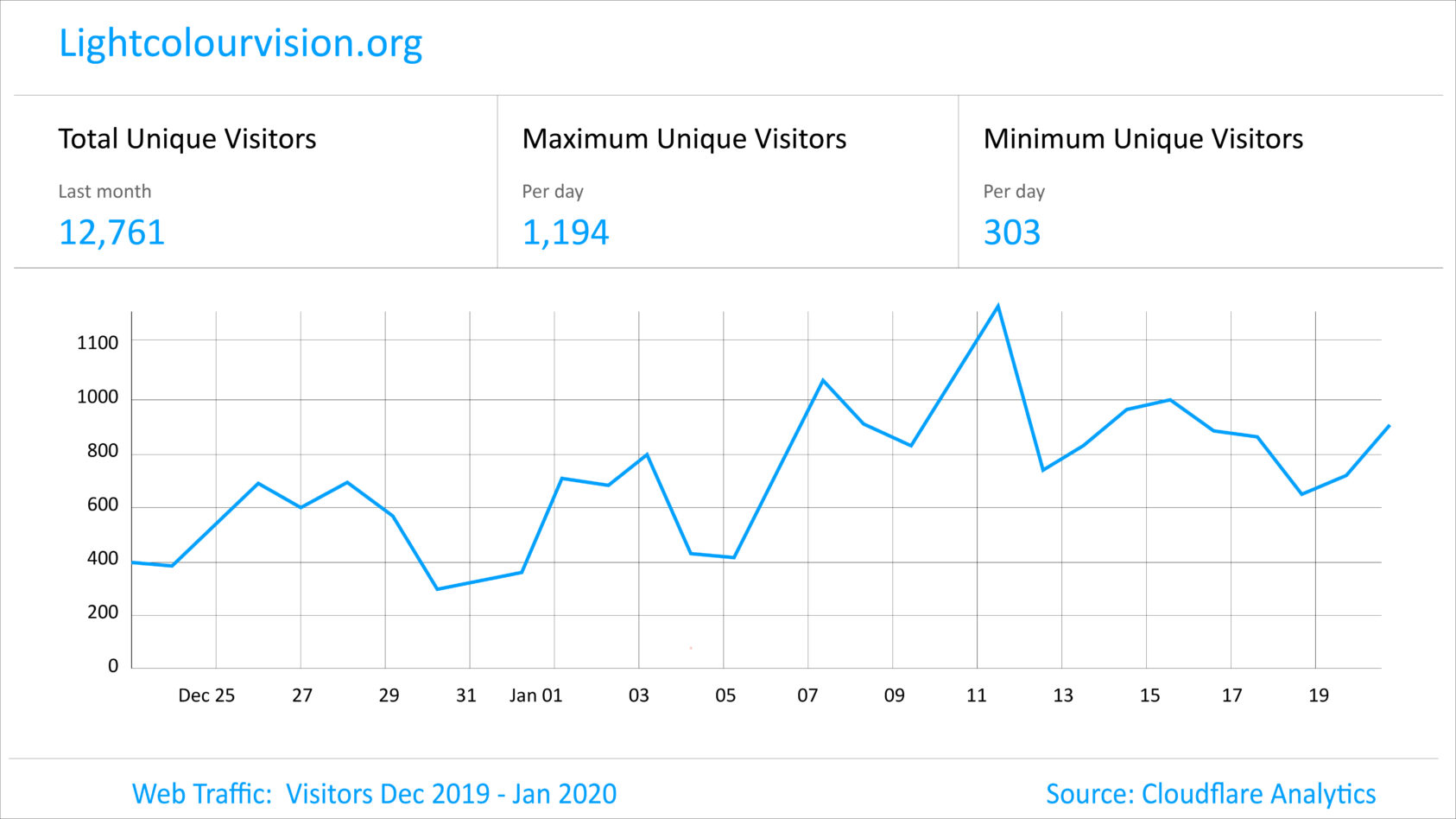
It is worth noting that the number of site visitors continues to grow steadily with well over 12,000 unique visits per month. This seems quite extraordinary and a wonderful affirmation that we are on the right track. It seems that most visitors arrive via a search engine, landing on a page matching their search terms. A simple test of this is to type light colour vision into the search bar of any browser. The results of an image search will produce anywhere between 10 and 40 results from our site. As time goes on, it should be possible to improve the relevance of the returned results as we focus more effort on SEO (search engine optimization).


SITE DEVELOPMENT

Our overarching focus as we develop the site is how best to bind together our core values, short-term objectives and long term goals. Let’s review the three of them now.

Core values

Lightcolourvision.org challenges contemporary threats to open, diverse, inclusive and well-informed communities by advocating and demonstrating an appreciation of and care for each other and our world. To achieve this, we disseminate information and promote discussion of the very real processes that interconnect and sustain us on planet earth.

We are committed to responding to the call for people to make web-content that is rich and relevant to communities that respect civil discourse and human dignity and use the open web as a global public resource for people everywhere.

Lightcolourvision.org is designed as a multi-disciplinary curriculum resource able to function effectively within a range of educational contexts. But it is also designed to play a part in ongoing, voluntary, and self-motivated life-long learning. In both contexts, it aims to explore new and radical approaches to active citizenship, self-development and creative practices.

Short-term objectives

Our short-term objectives for 2020 are all about building on our 2019 successes. In summary, we have four main areas of focus:

  1. Functionality: Improve functionality regardless of the device used to view the site.
  2. Content: Add more content and improv how visitors navigate to the resources they need.
  3. Fundraising: The first target for the year is to cover our basic running costs. You can see our Budget: Basic running costs 2020 here. We need to raise NZ$1716.00. After that, it’s going to be about developing strategies to attract patrons, sponsors and regular donors.
  4. Online-community: We want to reach out to teachers and educators in Aotearoa New Zealand this year and develop our 2020 strategy through a more collaborative approach.

Long-term goals

We introduced some of the thinking about the connection between our short-term objectives and long-term goals in the last newsletter. Put simply, the website currently contains resources that investigate the connections between light, colour and vision and explores how they shape our understanding of ourselves and the world. But we want to go further and explore how we can change the way we see ourselves, each other and our world in ways that enable us to address the pressing challenges we are all facing in communities everywhere. We want to explore how to see more in both quantitative and qualitative terms and how to move beyond habitual and uncritical ways of viewing things, to see the world afresh, through new eyes.

Our 2020 strategy

With all of the above in mind,  we are putting a heavy focus on the site’s bi-line how to see more this year. At the same time, we are also making a major change to our approach to site development. The plan is to produce some material by running workshops. So we have begun work preparing for a workshop that explores the prerequisites of seeing more. In practice, this will mean that instead of starting with the physics of light and the biology of vision we will be looking at how to develop better ways of seeing.

Confused? Hang in with us! We are hard at work and will be uploading new material very soon!!

KEEP IN TOUCH
Thank you for reading our January 2020 Newsletter. We would love to hear from you. Please share your thoughts by clicking on the menu button on the left 🙂 Ric Mann. March 2020.

Posted on

Campaign page 2024

Kia ora and welcome

We would like to warmly welcome you to the Campaign Page for our non-profit website lightcolourvision.org

We created lightcolourvision.org to be an empowering and inspirational resource for students, educators and researchers of all ages who share our interest and concern for the lives and education of future generations.

As its name suggests the site explores light, colour, vision and how to see more. You can navigate to other pages on the site using the menu at the top-left of the page.

Donate Now
Even the price of a coffee will help us pay the bills 🙂

2019: Launch and proof of concept

We opened lightcolourvision.org for business with a launch party and crowdfunding campaign in May 2019.  50 supporters helped raise NZ$2745.00 which enabled us to go public and start to map out the road ahead. By the end of the year, the site contained over 550 pages and visitor numbers had grown to 12,000 per month. The table below provides a summary of the resources now available to visitors (all resources are free to download).

Lightcolourvision Aug 2024
Published Description
 
Articles 4 We are in the process of publishing a series of fully illustrated articles exploring light, colour, vision and how to see more.
Diagrams
209 This library of DIAGRAMS includes the suite of images we have created and supports them with full-page explanations and related information.
Dictionary
513 The DICTIONARY includes definitions, explanations, summaries and ‘about ‘pages relating to the key terms used across the site. Each term has its own separate page.
Questions and answers 277 The site includes a library of general-knowledge Q&A’s about light. colour and vision..

2020-22: Building on our success

2020-22 is about building on our successes to date. We have big plans with three main areas of focus:

  1. Content: Adding more content to the site and improving how visitors navigate to the resources they need.
  2. Fundraising: The first target for each year is to cover our basic running costs. You can see our Budget: Annual running costs here.

2023-25: Building on our success

We continue to build the site, adding new material on a day-to-day basis.

  1. Navigation: Huge improvements have been made in the way visitors navigate the site and the way content appears. This work is ongoing.
  2. Content: New content is continually being generated. In the background, work is ongoing on our series of articles.
  3. Fundraising: Most users are happy to navigate the site to find the information they need. 39,000 visitors have called by in the last 12 months. All resources are free to download. Almost all donations we receive are from personal friends.
  4. See our blog  here for the latest updates

Donate Now
The price of a coffee will help 🙂

How you can help!

Explore the site and send us your feedback! What you see today is our proof of concept, a prototype demonstrating masses of functionality and a wide range of different types of content. We are keen to receive your thoughts and feedback on our efforts to date! So please use the feedback button on each page, and help us big-time with your comments.

Make a donation! Our first financial target is always to meet our basic running costs. So, we hope our efforts to date will inspire you to support what we are doing and help us build to the next level. You can make a donation using one of the panels on the right (Below on mobile).

Get involved! Become a lightcolourvision.org citizen. Find out more here.

The story so far

Over the last three years, we have developed the original concept for lightcolourvision.org into a fully-functioning website. Important choices have now been made between different kinds of functionality and features, and we have added a huge amount of content to this prototype. Visitors can now see the result of our efforts including pages and pages of content in both the DIAGRAMS library and the DICTIONARY.

During 2020 we hope to spread our wings further and start to build a bigger community around the site. With a little help, we plan to reach out first to organizations and individuals across Aotearoa New Zealand.

The vision

The website celebrates the common ground that binds human beings together in ways that we hope everyone can identify with.

Our approach to developing content is shaped by the fact that our thoughts are focused first on young minds and how to support them to make sense of themselves and their world.

Lightcolourvision.org challenges contemporary threats to open, diverse, inclusive and well-informed communities by advocating and demonstrating an appreciation of and care for each other and our world. To achieve this, we disseminate information and promote discussion of the very real processes that interconnect and sustain us on planet earth.

We are committed to responding to the call for people to make web-content that is rich and relevant to communities that respect civil discourse and human dignity and use the open web as a global public resource for people everywhere.

Lightcolourvision.org is designed as a multi-disciplinary curriculum resource able to function effectively within a range of educational contexts. But it is also designed to play a part in ongoing, voluntary, and self-motivated life-long learning. In both contexts, it aims to enhance active citizenship, personal development and self-sustainability.

Thank you to everyone who helped us make 2019 such a success!!

YES!! To all of you, our supporters, THANK YOU AGAIN 🙂

Love and best wishes from Ric, Jules and Melissa

**

The core team

We are Ric Mann and Jules Turner, the founders and the initial contributing editors of lightcolourvision.org. You can read background information and our personal statements here.

And in case you were wondering, yes, everything you see on the site today has been produced on a voluntary basis because we are both committed to this project big time!!

GOALS FOR 2024-5

Goals for 2024-5

Three over-arching goals for 2024-5 are outlined below:

2024-5 GOAL ONE: Create more content
Lightcolourvision.org is not yet complete. New content is being developed and added all the time. Publishing new material as well as refining existing content is the life-blood of the site!!


2024-5 GOAL TWO: Add more hand-crafted articles
Creating articles is a labour of love. It can take up to a year to develop and publish a new article. We hope eventually to produce a package of sixteen hand-crafted, illustrated articles that link our central topics of inquiry – light, colour, vision and how to see more.

Each article introduces and explores the interlinking clusters of concepts and terms that are used across the site. They also help to expose the underlying research interests that motivate us as we develop the site.

We have just published an article about electromagnetism. It has been the most demanding enterprise yet. It has taken a whole year of research and development to get to the point where it is ready to publish but is finally ready to share.


2024-5 GOAL THREE: Build a community of citizens
In educational terms, an effective community enables its members to set goals, develop key competencies and realize their full personal and social potential.

We hope that everyone who uses our site recognizes that they are valued members of the lightcolourvision.org community.

We see the idea of citizenship not as a static concept but as part of the process of growing an online community through a step-by-step process.

But in reality it is a challenging aspiration. Around 40,000 people a year visit the site, find what they need and move on leaving no trace. Even feedback is very rare. However the aspiration remains a crucial focus.

OUR AUDIENCE

Who is it lightcolourvision.org for?

Students

Lightcolourvision.org aims to enable students involved in their own lines of inquiry – writing essays, developing presentations, preparing resources or creating artwork. Others may use the site to check facts or to improve their understanding of the topics we cover.

Educators

The site aims to resource teachers and educators who need to access resources that enable them to engage students with the topics we cover.

Our articles, for example, aim to provide consistently argued overviews of topics that, draw on families of concepts and terms and are supported by a knowledge-base of definitions, explanations and additional information.

Our diagrams aim to provide an engaging and informative visual counterpoint to discussion within each topic.

Researchers of all ages

Our own academic, professional and personal research underpins the website. Our interests span the visual arts, the philosophy of design, visual arts education and curriculum development. We see lightcolourvision.org as a beacon for discussion of contemporary issues in a shadowed world.

We recognise that the needs of these three interest groups differ. With this in mind, the site targets a general readership first. As a result, content is organised so that the most accessible information is presented first, followed by additional content and links to further resources. Terms and concepts follow the same pattern, meaning that new vocabulary is introduced step by step and point by point.

Research Classroom Student General
Images ???? ???? ???? ????
Explanations ???? ???? ???? ????
Downloads ???? ???? ???? ????
In-line links ???? ???? ????
Bibliography ???? ???? ????
Q&A’s ???? ???? ????
Articles ???? ????
Citizenship ????

The relevance of content to different types of users

CURRENT FEATURES

A list of current features and links to examples

Features Details Examples
Images Library of images in the form of diagrams and slides supported by full-page explanations Example
Articles Library of illustrated articles exploring light, colour, vision and how to see more Example
References Reference library of key terms used across the site including definition, explanation and bullet points Example
Q&A’s Pop-up general-knowledge Q&A’s with in-text links to the reference library Example
In-line links Functionality that highlights keywords and links to the reference library Example
Bibliography In-line citations and footnotes are used throughout the site and link to the bibliography.
Free downloads Functionality to download images and articles in formats suited to a range of different uses Example
Citizenship Functionality to enable and encourage user involvement

Table showing the existing features of lightcolourvision.org

FUNDRAISING AND ACCOUNTABILITY

Lightcolourvision.org operates under the auspices of MediaStudies Trust, an incorporated society registered as a Charitable Trust in New Zealand. The financial management of lightcolourvision.org, including all forms of fundraising and financial accountability, is the responsibility of the trust.

All funding campaign for lightcolourvision.org are intended to encourage support, involvement and collaboration in the project and help fund project development.

On-line fundraising powered by

Fully secured payment gateway

DONATE NZ$20 (£10.50)

RECEIVE: Citizenship
Because you know you made a real difference!

INCLUDES:
Honorary citizenship (with no obligations).
Regular newsletter containing project updates.
Appreciation and thanks measured in tons.
**
Donate NZ$20.00 now

DONATE NZ$50 (£25.80)

RECEIVE: Citizenship (Honours)
Because you know you made a major difference!

INCLUDES:
Honorary citizenship (with no obligations).
Regular newsletter containing project updates.
Appreciation and thanks measured in tons.
**
Donate NZ$50.00 now

DONATE NZ$100 (£46.89)

RECEIVE: Citizenship (1st Class Hons)
Because you know you made a huge difference!

INCLUDES:
Honorary citizenship (with no obligations).
Regular newsletter containing project updates.
Appreciation and thanks measured in tons.
**
Donate NZ$100.00 now

Lightcolourvision.org is a non-profit project operating under the auspices of MediaStudies Trust, an incorporated society registered as a charitable trust in New Zealand

Posted on

Campaign page 2019

Kia ora and welcome

We would like to warmly invite you, as a member of our closest circle of friends, family and colleagues, to the launch of lightcolourvision.org, our brand-new non-profit website.

We have created lightcolourvision.org as an empowering and inspirational resource for students, educators and researchers of all ages who share our interest and concern for the lives and education of future generations.

The video above provides an introduction to the project and you can explore the rest of the website using the menu at the top of the page.

Come to the launch party

Your invitation to our launch party is in the panel below, so please RSVP and join us for a celebratory glass of bubbles as we thank everyone who has supported us on the journey so far and as we map out the road ahead.

Join our funding campaign

As part of our launch, we are running a crowdfunding campaign. You can help us by pledging right now using the panel on the right (below on mobiles). At this point, a pledge will make a massive difference as we set new milestones and pursue ongoing funding.

We aim to raise a minimum of NZ$2500. If things go well and we raise more, all additional amounts will go towards our current aspirations of raising NZ$12,000 during 2019. You can see an outline of our budget for 2019 here.

You can read an extract of the small print for our crowdfunding campaign here.

Visit the site and send your feedback

What you see today is our proof of concept, a prototype demonstrating both functionality and a range of different types of content. We are keen to receive your thoughts and feedback!

Read the paragraphs below to clarify what lightcolourvision.org is all about and then use the feedback button on each page, and help us big-time with your comments.

**

CROWDFUNDING CAMPAIGN

PLEDGES RECEIVED

Name Amount (NZ$)
Anon 20.00
Miriam Kauders 100.00
Kim Theeman 100.00
Gwynn Rees 20.00
Trisha Murdie 30.00
Elisabeth Vaneveld 50.00
Oli Allen 20.00
Oliver Copsey 50.00
Anon 50.00
Bron and Kent Shelley 50.00
Simon Smith 20.00
Zoe Copsey 20.00
Michele Johnson 20.00
Jo Goffe-Robertson 50.00
Stuart Mackay 10.00
Katie Skinner 25.00
Rachel Mann 200.00
Anita Heffernan 30.00
Rya Allen 120.00
James Baysting 50.00
Anon 20.00
Tan Copsey 200.00
Annette Ashton 50.00
Sharon Allen 20.00
Jennifer Del Bel 200.00
Kaaren Hiyama 50.00
Naomi Forrester 10.00
Nabahet Hamdi 50.00
Sarah Crane 50.00
Eric Moskowitz 100.00
Guy Farrar 40.00
Peter and Joyce Mann 200.00
Yvonne Shorten 50.00
Michael Ellis 50.00
Max The Dog 10.00
Monica Mann 50.00
Catherine Boyd 20.00
Janette Vercoe 30.00
Michael Demchy 100.00
Lucy-Mae Sparkle 20.00
Anon 20.00
Sam Simmons 20.00
Melissa Durbin 100.00
Anon 200.00
Jennifer Salmon 20.00
Julie Swasbrook 30.00
Vonney Ball 50.00
Debbie and Paul Lawrence and Barber 50.00
Phill Rooke 40.00

NZ$ 2745.00 TARGET ACHIEVED!!

CAMPAIGN ENDED

12.00pm GMT 21st May 2019

**

Thank you

Thank you to everyone for your pledges. If you are having any problems making a pledge please Contact us.

Viewing this on your mobile? To see the full story swap over to your laptop.

To all of you, our supporters, THANK YOU AGAIN 🙂

Love and best wishes from Ric and Jules

The story so far

Over the last three years, we have developed the original concept into a fully-functioning website. It involved researching and making choices between different kinds of functionality and features, then designing and building this prototype. Visitors to the site can now see the result of our efforts including examples of a wide range of different types of content.

We now think the time has arrived to share the process we have worked through so far and celebrate the milestones that are behind us.

It’s also time to spread our wings a little and start to build on the community around the site. With your help, we hope to use our social networks as part of a strategy to reach out first to organisations and individuals across Aotearoa New Zealand.

Inevitably, we have had to cover the development costs so far. So, we are hoping that at this crucial point we can inspire all those who know and support what we are doing, to join our first fundraising effort.

We are confident that, with enough support, we can build on the proof of concept, the launch and the funding campaign to develop the initiative to the next level.

The vision

The website celebrates the common ground that binds human beings together in ways that we hope everyone can identify with.

Our approach to developing content is shaped by the fact that our thoughts are focused first on young minds and how to support them to make sense of themselves and their world.

Lightcolourvision.org challenges contemporary threats to open, diverse, inclusive and well-informed communities by advocating and demonstrating an appreciation of and care for each other and our world. To achieve this, we disseminate information and promote discussion of the very real processes that interconnect and sustain us on planet earth.

We are committed to responding to the call for people to make web-content that is rich and relevant to communities that respect civil discourse and human dignity and use the open web as a global public resource for people everywhere.

Lightcolourvision.org is designed as a multi-disciplinary curriculum resource able to function effectively within a range of educational contexts. But it is also designed to play a part in ongoing, voluntary, and self-motivated life-long learning. In both contexts, it aims to enhance active citizenship, personal development and self-sustainability.

The team

We are Ric Mann and Jules Turner, the founders and the initial contributing editors of lightcolourvision.org. You can read background information and our personal statements here.

GOALS FOR 2019

Goals for 2019

Three over-arching goals for 2019 are outlined below:

2019 GOAL ONE: Commission the redesign of the site
The current design of lightcolourvision.org reflects the process we have worked through towards the proof of concept.

An important goal for 2019 is to give the site a contemporary interface with architecture that enables us to move from a free-standing resource to a platform that enables citizens (registered users) to get involved as contributing editors etc.

This means commissioning a web-designer who understands our values-based objectives and can provide the site with a corresponding look and feel. They will also help us to develop functionality that enables citizens to engage with one another in discussion and moderation of existing content and also enable them to create new resources.


2019 GOAL TWO: Complete all sixteen hand-crafted articles
Complete the package of sixteen hand-crafted and illustrated articles that link our central topics of inquiry – light, colour, vision and how to see more.

These articles introduce and explore the interlinking clusters of concepts and terms that are used across the site. They also help to expose the underlying research interests that motivate us as we develop lightcolourvision.org.

The intention is that these articles clearly demonstrate the quality of content we aspire to.


2019 GOAL THREE: Build a community of citizens
In educational terms, an effective community enables its members to set goals, develop key competencies and realise their full personal and social potential.

We hope that everyone who signs-in, subscribes to our newsletter or provides feedback recognises that they are valued members of such a community.

The idea of citizenship has already been introduced but growing an online community as clearly a step-by-step process.

An important step for 2019 is to develop functionality so that visitors who sign in as contributing editors can communicate directly with one another and so enable a decentralised community of citizens with shared interests and a sense of shared ownership of its content.

AUDIENCE

Who is it lightcolourvision.org for?

Students

The website aims to enable students involved in their own lines of inquiry – writing essays, developing presentations, preparing resources or creating artwork. Others may use the site to check facts or to improve their understanding of the topics we cover.

Educators

The website aims to resource teachers and educators who need to access resources that enable them to engage students with the topics we cover.

Our articles, for example, aim to provide consistently argued overviews of topics that draw on families of concepts/terms supported by a knowledge-base of definitions, explanations and additional information.

Our diagrams aim to provide an engaging and informative visual counterpoint to discussion within each topic.

Researchers of all ages

Our own academic, professional and personal research underpins the website. Our interests span the visual arts, the philosophy of design, visual arts education and curriculum development. We see lightcolourvision.org as a beacon for discussion of contemporary issues in a shadowed world.

We recognise that the needs of these three interest groups differ. With this in mind, the site targets a general readership first. As a result, content is organised so that the most accessible information is presented first, followed by additional content and links to further resources. Terms and concepts follow the same pattern meaning that new vocabulary is introduced paragraph by paragraph.

Research Classroom Student General
Images ???? ???? ???? ????
Explanations ???? ???? ???? ????
Downloads ???? ???? ???? ????
In-line links ???? ???? ????
Bibliography ???? ???? ????
Q&A’s ???? ????
Articles ????
Citizenship ????

The relevance of content to different types of users

TARGETS FOR 2019

Targets for 2019

We have a set of targets for 2019 to do with adding content. You can get a sense of the range of tasks from the table below:

Targets for 2019
Details
Edit and proof Everything uploaded to date needs a final edit and proof
Images Upload fully researched but unfinished content
Articles Final edit and upload three more completed articles about colour
Bibliography Add in-line citations, footnotes and bibliography
Photography Establish the photography section

Working on the design and functionality of the site is a distraction from developing new content that we hope to overcome during 2019. The chart below shows progress so far towards our targets for the year.


Site content: Progress towards 2019 targets

CURRENT FEATURES

A list of current features and links to examples

Features Details Examples
Images Library of images in the form of diagrams and slides supported by full-page explanations Example
Articles Library of illustrated articles exploring light, colour, vision and how to see more Example
References Reference library of key terms used across the site including definition, explanation and bullet points Example
Q&A’s Pop-up general-knowledge Q&A’s with in-text links to the reference library Example
In-line links Functionality that highlights keywords and links to the reference library Example
Bibliography In-line citations and footnotes are used throughout the site and link to the bibliography.
Free downloads Functionality to download images and articles in formats suited to a range of different uses Example
Citizenship Functionality to enable and encourage user involvement

Table showing the existing features of lightcolourvision.org

CROWDFUNDING: DETAILS

How our crowdfunding campaign works

Lightcolourvision.org is a project which operates under the auspices of MediaStudies Trust, an incorporated society registered as a charitable trust in New Zealand. The financial management of lightcolourvision.org including all forms of fundraising is the responsibility of the trust.

Our crowd-funding campaign for lightcolourvision.org is intended to encourage collaboration in the project and help fund development through 2019.

The campaign begins on 1st May 2019 and finishes at 12.00pm GMT on the 21st May 2019

A pledge is an amount that a supporter offers to contribute if the crowdfunding campaign is successful.

The campaign will be successful if it reaches or exceeds the funding goal of $2500 by the close date.

If the campaign doesn’t reach its funding goal, then supporters will not be asked to settle their pledges.

If the crowd-funding campaign is a success, then supporters will receive an email offering various ways to transfer the pledged amount.

Two further attempts will be made to collect pledged amounts.

If these efforts are unsuccessful the pledge will be recorded as unpaid, but the amount pledged will be counted towards the success of the campaign.

Any donations made to lightcolourvision.org during the crowdfunding campaign will be counted alongside pledges.

Supporters can only make one pledge to the campaign. If a second pledge is received it will be considered as an amendment of the first.

Please contact Ric and Jules directly or through the website with any questions.

Footnote

Lightcolourvision.org is intended to be a 10-year project. It’s a kind of life work at the point where Ric and Jules’ research interests overlap. Health and everyday circumstances permitting, it will continue to develop. It is assumed that when supporters make pledges and donations to lightcolourvision.org they accept the unforeseeable risks and challenges faced by the project.

PLEDGE NZ$20 OR MORE (£10.50)

RECEIVE: Citizenship
Because you made a real difference!

INCLUDES:
Honorary citizenship (with no obligations).
Regular newsletter containing project updates.
Appreciation and thanks measured in tons.
**

PLEDGE NZ$50 OR MORE (£25.80)

RECEIVE: Citizenship (Honours)
Because you made a big difference!

INCLUDES:
Honorary citizenship (with no obligations).
Regular newsletter containing project updates.
Appreciation and thanks measured in tons.
**

PLEDGE NZ$200 OR MORE (£103.30)

RECEIVE: Citizenship (1st Class Hons)
Because you made a huge difference!

INCLUDES:
Honorary citizenship (with no obligations).
Regular newsletter containing project updates.
Appreciation and thanks measured in tons.
**

Lightcolourvision.org operates under the auspices of MediaStudies Trust, an incorporated society registered as a charitable trust in New Zealand

Posted on

Sense-making

Quote

As living, conscious beings we strive to make sense of the world. There is always more to understand than the small part we see clearly.  The precise course of our lives depends on ensuring that we are critically informed and respond creatively to how things appear.

A STARTING POINT

A simple description of the challenge that all human beings face concerns the correspondence between organism and environment. In purely physical terms the boundary between the two follows the contours of our skin and there is a significant difference between the inside and outside until our lives come to an end.

The relationship between the living organism on the inside and the environment on the outside is mediated by the epidermis, where blood and tissue interface with air. Nerves, embedded in every square inch of the surface of our skin, enable tiny changes in the immediate environment to be sensed. Other nerves within the nose and mouth collect their own sensory impressions. Add to this a proprioceptive awareness of our own movements and sense of balance, then, taken together, these sensations provide an essential avenue to assembling our understanding of both ourselves and the world.

Obviously, there are two other organs evident on the surface of our bodies that vastly expand our relationship with the world outside. They are hearing and vision. Of these two it is vision that provides the principal focus on subsequent pages.

To add vision to the picture outlined so far involves our eyes, optic nerves and brain. All three can be counted as component parts of a single organ, a large part of which is safely embedded within our skulls, but with the eye-balls mounted as high up and as far forward as possible from where they provide a panoramic view of the world.

It may already be clear that this idea of human existence as a transactional relationship grounded in being-in and being-of the world in a purely physical sense is too simplistic. Our lives stretch far beyond the reach of our sensory organs. Our immediate circumstances run out into global networks, allowing us to engage in transactions worldwide. We can climb into machines that whisk us off to distant locations that our bodies alone could never reach. Connect the human mind to a microscope and we can see into the infinitesimally small world of neurons and synapses that power vision and conscious perception. When we do an internet search, or access libraries online, we unlock petabytes of knowledge of ourselves and the world accumulated over centuries.

But, in a very real sense, it is visual perception that provides the key to this array of perspectives on our very human condition. Vision brings our experience of the world into sharp relief and fills every corner with colour.

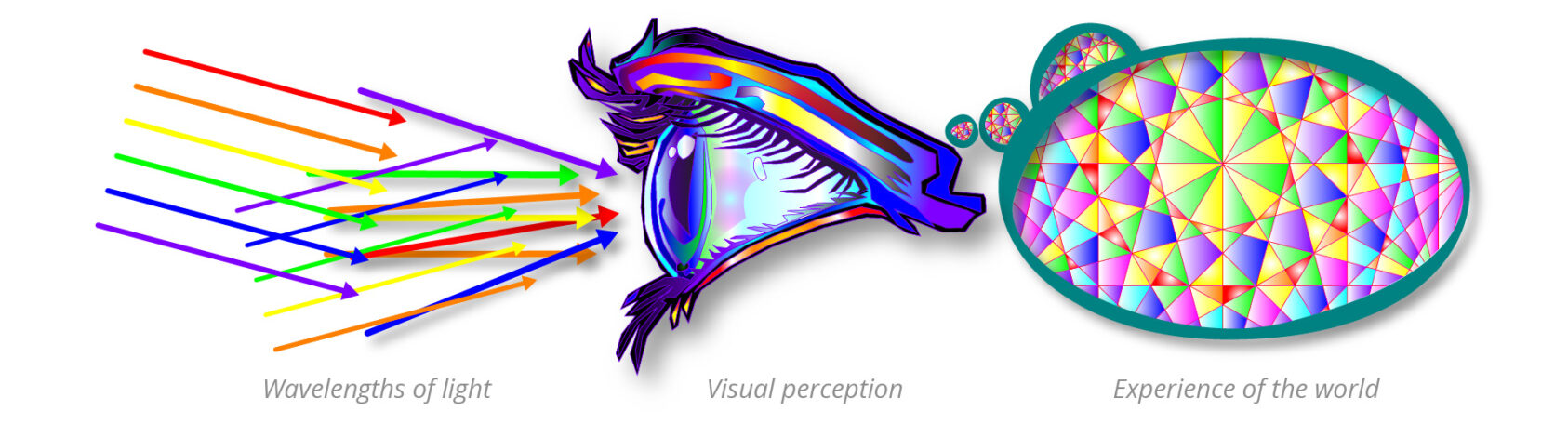
Light of different wavelengths enters the human eye. The role of our brains is to makes sense of those fleeting patterns.

With the thoughts outlined so far in mind, consider the following three points:

  • Colour sensations are always available to us whether we are aware or pay attention to them or not. Colour is what human beings see in the presence of light.
  • Colour is an artefact of human vision, something that only exists for living things like ourselves.
  • Seeing is a sensation produced by light and takes the form of colour. If human beings and related species were all to disappear overnight, the world would still be full of light but there would be no colour.

In the sections that follow, four closely related terms are introduced that help to build on the ideas introduced so far. They are visual perception, colour vision, the perception of colour and sense-making.

This diagram demonstrates the relationship between wavelength and colour. Nanometres (nm) is a unit of measurement for wavelength.

ATTRIBUTES OF VISUAL PERCEPTION

Attributes of visual perception are the innate abilities and the skills we develop over the course of a lifetime that enable us to make sense of what we see. They are evident in the diverse properties of the world we see around us.

Innate attributes of visual perception associated with the response of the human eye and brain to light include:

  • Colour perception: The ability to see colour in the presence of light including all the greys between black and white.
  • Visual attention: The ability to focus on important visual information and filter out the rest.
  • Sensory processing: Accurate registration, interpretation and coordination of visual information alongside other forms of sensory stimulation.
  • Visual discrimination: The ability to recognise differences or similarities between objects based on size, colour, shape etc.
  • Spatial relationships: The ability to understand the relationships of objects, particularly their position, distance, and direction of movement relative to an observer.
  • Stereo vision: The ability to see the world in three dimensions.
  • Figure-ground: The ability to locate something and treat everything else as a background.
  • Form constancy: The ability to know that a form or shape is the same, even if it becomes larger, smaller or its orientation changes.
  • Visual closure: The ability to recognise a form or object when part of it is hidden or missing.
  • Visual memory: The ability to recall the outline and details of a view or object.
  • Visual sequential memory: The ability to recall a sequence of experiences in the correct order.

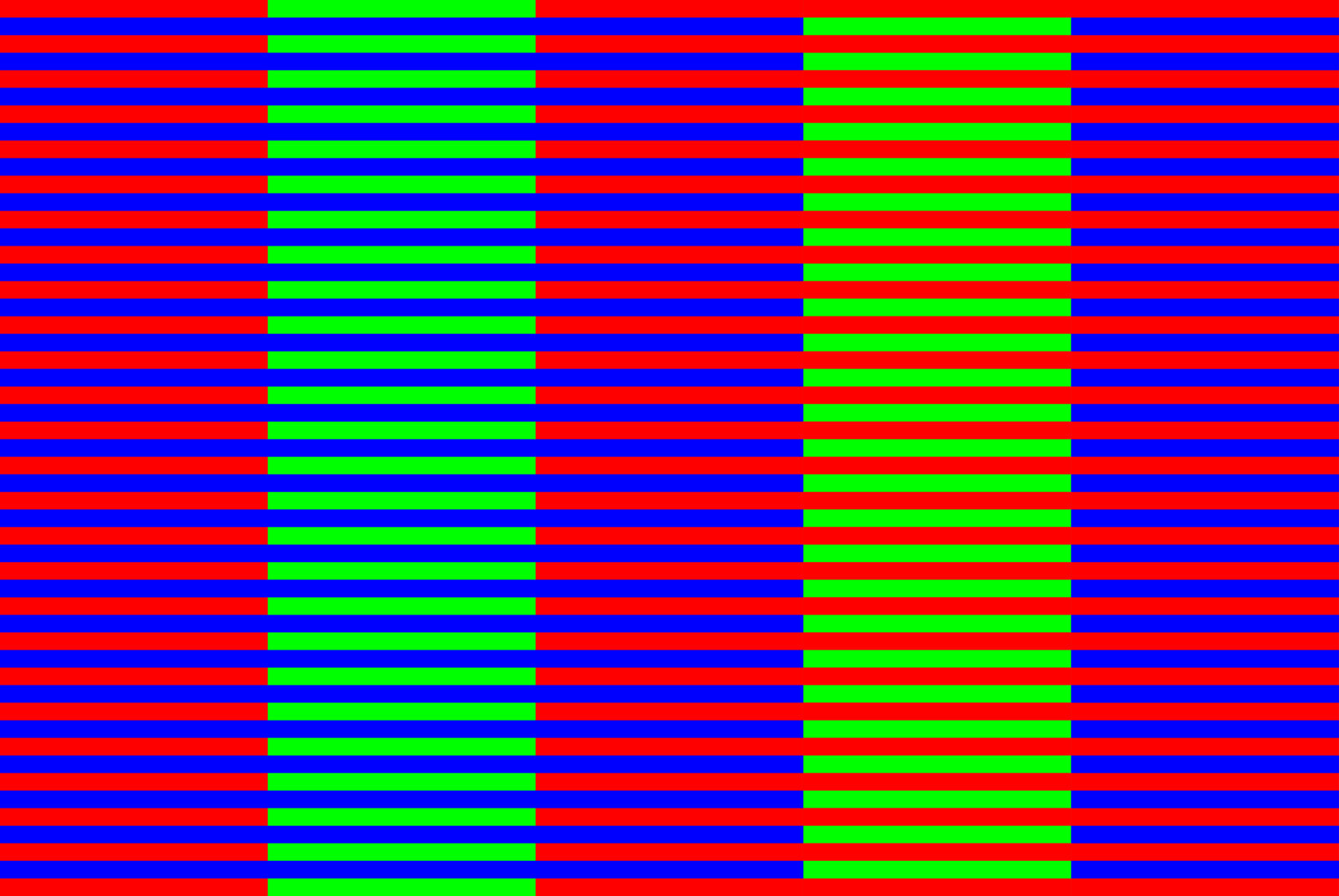
Our visual skills are remarkable but easy tricked. The two vertical bands of green are the same colour but appear to be different. Close inspection of the diagram reveals why!

COLOUR VISION

In terms of human experience, colour vision is the ability to distinguish objects according to the wavelengths and intensities of light they absorb, emit, reflect or transmit etc. The human eye and brain together translate light into colour.

  • Colour vision allows a human observer to distinguish objects by their colour.
  • Colours can be measured and quantified, but an observer’s perception of colour is first and foremost a subjective experience whereby the visual system responds to stimuli produced when incoming light reacts with chemicals inside the photosensitive rod and cone cells of the retina at the back of the eyeball.
  • In normal conditions, light is rarely of a single wavelength, so an observer is often exposed to a range of wavelengths in one area of the spectrum or a mixture of wavelengths from different areas of the spectrum.
  • In everyday life, colour vision includes chromatic and achromatic content. This means that an observer can distinguish between stimuli that appear coloured (chromatic) and others that appear to be without colour (achromatic) and so appear black, grey or white.
  • Different people may see the same object or light source in different ways. Factors that affect what we see include: where we are standing relative to an object, differences in eyesight (eg. colour blindness), previous experiences, expectations or interests.

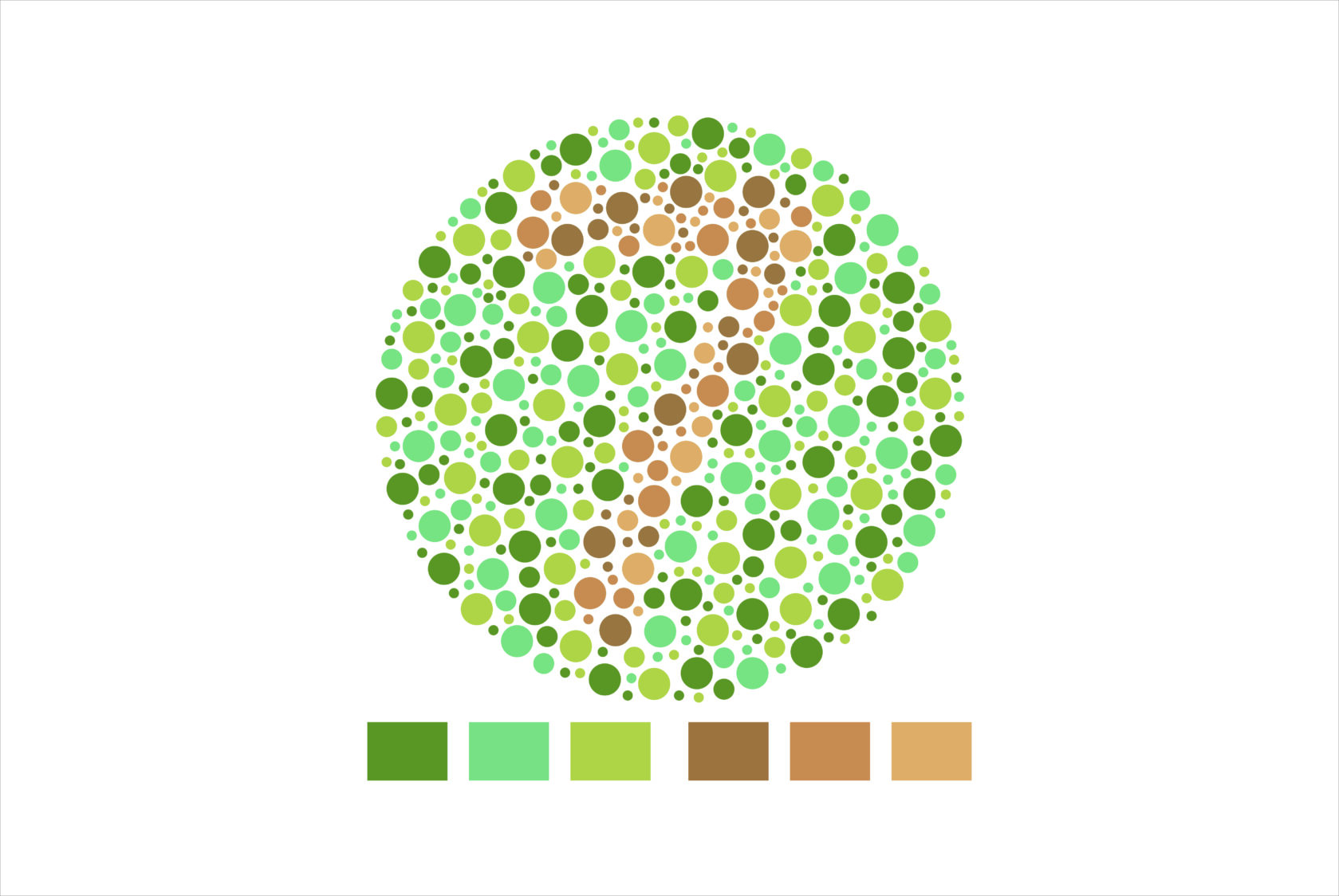
A person with normal vision will be able to distinguish a numeral in the pattern of dots shown above. A common form of colour blindness makes it difficult to distinguish between these greenish and redish hues. (https://en.wikipedia.org/wiki/Ishihara_test)
PERCEIVED COLOUR

The perceived colour of an object, surface or area within the field of vision results from colour perception – an attribute of visual perception. First and foremost, perceived colour refers to what an observer sees in any given situation and so is a subjective experience.

  • It is the human ability to perceive and distinguish between colours that provides an important basis for the way that we sense and make sense of the world.
  • A distinction can be made between the physical properties of things in the world around us and how they appear to a human observer. So a small rock in a garden can be described in terms of physical properties but these don’t explain why, in the same situation,  a child sees a cat moving in the shadows.
  • When thinking about perceived colour, a distinction can be made between:
    • The properties of light.
    • The properties of objects.
    • What an observer perceives as a result of the attributes of visual perception.

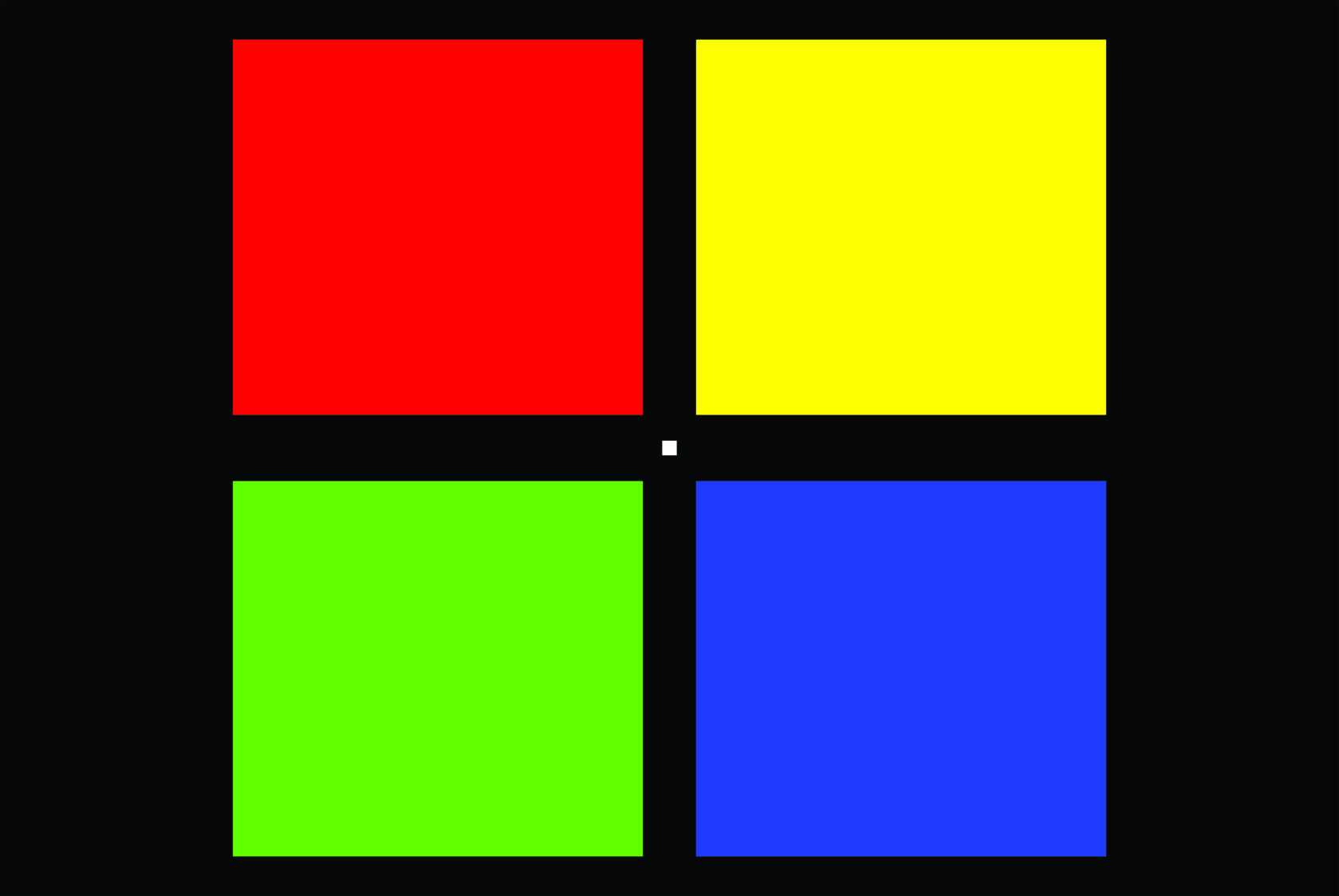
Looking steadily at strong colours confuses the light sensitive cells in our eyes. The cells don’t recover immediately when we look away. Stare at the white square in the diagram without blinking for at least 15 seconds. Now close your eyes. Can you name the colours in the after-image?

  • Perceived colour can be described by chromatic colour names such as pink, orange, brown, green, blue, purple, etc., or by achromatic colour names such as black, grey and white etc. Colour names can be qualified by adjectives such as dark, dim, light, bright etc.
  • Perceived colours consist of any combination of chromatic and achromatic content.
  • Perceived colour depends on the spectral distribution of a colour stimulus – the range and mixture of wavelengths and intensities of light that enter the eye.
  • Perceived colour depends on factors such as the size, shape and structure of all the objects in view, the composition and texture of their surfaces, their position and orientation in relation to one another, their location within the field of view of an observer and the direction of incident light.
  • Colour perception can be affected by the state of adaptation of an observer’s visual system. An example of this is when the photosensitive cells embedded in the retina become fatigued from long exposure to a strong colour and then produce an afterimage when we look away.
  • Perceived colour is influenced by factors such as an observer’s expectations, priorities, current activities, recollections and previous experience.
  • Perceived colour is defined in the International Lighting Vocabulary of the CIE (The International Commission on Illumination) as a characteristic of visual perception that can be described by attributes of hue, brightness (or lightness) and colourfulness (saturation or chroma) (CIE, 2011, 17-198).

SENSE MAKING

An important factor when considering visual perception is that as light enters our eyes it does not have any properties that allow it to carry information about the world of objects and the other things, we so easily recognise around us. The only type of information carried by light that our eyes can register is related to properties such as wavelength, frequency and intensity. Therefore, the sense-making process gathers nothing more from photosensitive cells in the retina other than flickering patterns of light.

But if this is the case then how do we make sense of the world? Let’s look at the basics of sense-making in more detail!

Most people are familiar with the idea that colours do not have an external objective existence. This understanding has a grounding in physics. Light is composed of energy at different wavelengths and our eyes respond to one small band of those wavelengths within the electromagnetic spectrum. Anatomical studies have in turn revealed the existence and function of the light receptors in the retina of our eyes that respond to light.

So, there is no red out there in the world. What we call red is our visual system’s interpretation of what we are looking at. Our visual system constructs the experience of red from the data provided by our eyes. Despite all this, when I see a car, the fact that it is red is an indisputably accurate description of my observation. Somehow the redness of the car is a simple fact.

Neuroscience is currently trying to explain how this happens. What we know is that our visual system favours fast reaction times and rapid interpretation and there is nothing to be gained from the brain revealing its inner workings in the course of everyday experience. To the contrary, it specialises in providing us with just the information we need and in precisely the form we need it. We receive no information about how our eyes and brain gather or process information. The car just looks red and if we see a tiger then hopefully there is still time to run away as fast as we can!

A naïve view of sense-making

A lack of understanding of the act of seeing in favour of taking our sensory experience for granted is the basis of naïve realism. From this perspective, perception simply produces a mirror of the world around us, though our attention may swing inward at a moment’s notice if we feel pain or have a disturbing thought. But what we see around us is not just an internal reflection of an external reality!

Animal or bird? A healthy outlook involves skepticism about every we see. When it comes to perception, assumptions, bias, previous experience, expectations and prejudice can all play their part in how things appear.  The painting is by Tim O-Brian and was originally published in Nautilus Magazine.

A BOTTOM-UP VIEW OF SENSE-MAKING

Investigations over the last two centuries have revealed a lot about sense-making. So let’s consider a bottom-up perspective first, and the idea that what an observer sees and understands about the world starts as light enters the eyes and ends with conscious perception.

The core idea is that light, in the form of waves (sometimes described as particles called photons) bounce off things in front of us and enter our eyes through the pupil. The lens then focuses light on the retina at the back of the eye-ball where it forms an image. The retina, which contains photosensitive cells, responds by producing chemical and then electrical signals. The signals go through further processing by other types of neurons including ganglion and bipolar cells. The output is then dispatched along the optic nerve towards the visual cortex and related areas of the brain.

This view acknowledges research into the visual system that reveals connections going towards the eye from the brain and controlling things like eye movement, vergence (cross-eyes when looking at objects close-up), focus and blinking but points out that there are vastly greater numbers of connections going towards the brain.

From this perspective, sense-making is generally understood to develop stage by stage as signals are transmitted through the visual system. Different facets of perceptions of a recognisable world including colour, shape, depth, stereo vision and movement are all constructed progressively en-route, enabling us to compose pictures which integrate local details and global features of a scene into a comprehensible view of the world.

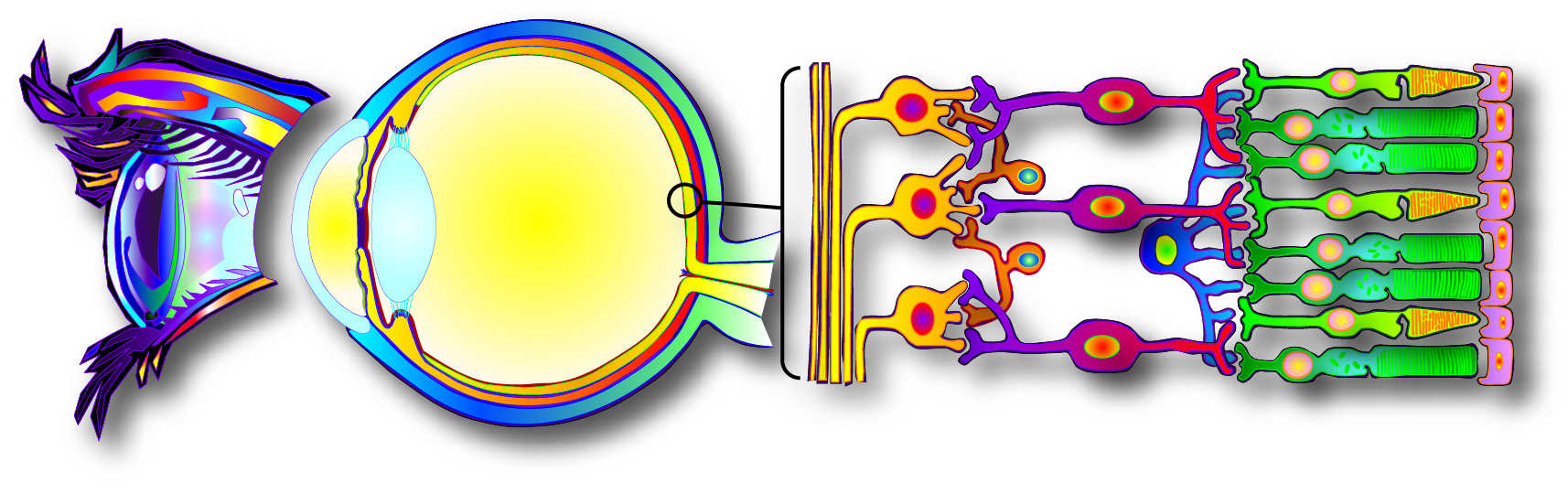
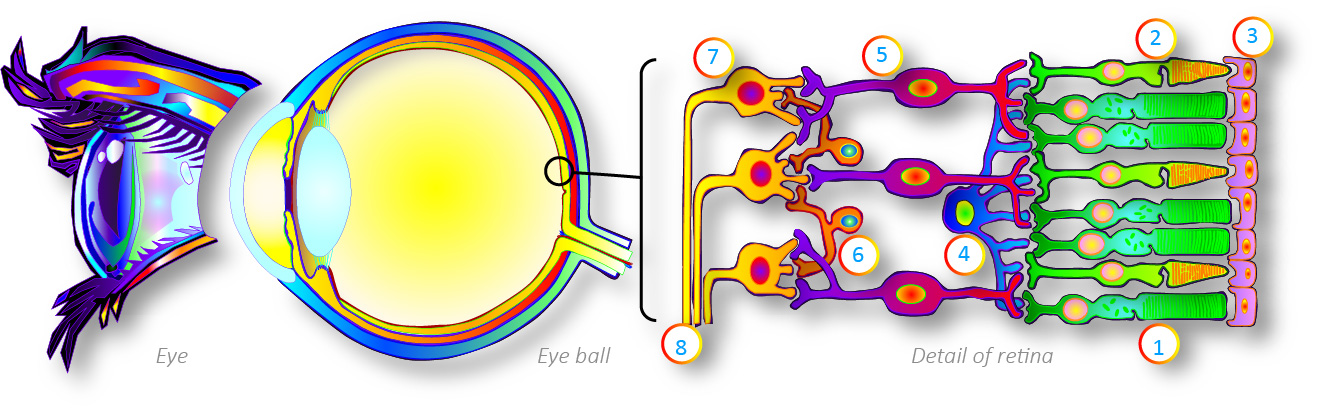
Light enters the eye, is focused by the lens and forms an image on the surface of the retina. The diagram shows a detail of the retina and the various kinds of neurons involved in translating this image into signals ready to be sent off along the optic nerve to the visual cortex within the brain. The table below identifies the different cell types.
Type of neuron Brief description
1 Rod cells Rods are light sensitive photo-receptor cells that sense the different wavelengths of light focused on the retina. Rods function in lower light than cone cells. Rod cells are almost entirely responsible for night vision but play almost no part in colour vision. Notice that both rod and cone cells are not on the surface of the retina where the image forms. They are attached instead to the pigment epithelium which forms the boundary between the retina and the eyeball.
2 Cone cells Cones are light sensitive photo-receptor cells that respond to the wavelength and intensity of light striking each microscopic point on the retina. They are responsible for colour vision. Cone cells function best in relatively bright light, as opposed to rod cells, which work better in dim light.
3 Pigmented  epithelium Pigment epithelium is a layer of cells at the boundary between the retina and the eyeball. These cells nourish the different types of neurons within the retina. The pigment epithelium is attached to the underlying choroid that forms the inner surface of the eyeball on one side and to rods and cones on the other.
4 Horizontal cells


Horizontal cells help to integrate and regulate information received from photo-receptor cells, cleaning up and globally adjusting signals as they pass through bipolar cells towards the regions containing ganglion cells.
5 Bipolar cells Bipolar cells act, directly or indirectly, as conduits through which to transmit signals from photo-receptors (rods and cones) to ganglion cells.
6
Amacrine cells Amacrine cells interact with bipolar cells and/or ganglion cells. They monitor and augment the stream of data through bipolar cells and also control and refine the response of ganglion cells and their sub-types.
7 Ganglion cells Ganglion cells collect and process all the visual information gathered directly or indirectly from the forty-something types of rod, cone, bipolar, horizontal and amacrine cells and, once finished, transmit it towards higher visual centres via the optic nerve.
8 Optic nerve The optic nerve is the cable–like grouping of nerve fibres formed from the axons of ganglion cells that transmit visual information towards the lateral geniculate nucleus and then onward towards the visual cortex. The optic nerve begins at the optic disk, a point on the retina often called the blind spot.

A TOP-DOWN VIEW OF SENSE-MAKING

Now let’s consider a top-down view of the same sense-making process. This suggests that the chemical and electrical processes resulting from light stimulating the eyes occur simultaneously with other types of neurological activity within the brain. From this perspective, conscious perceptions are as much to do with brain activity as they are to do with raw information gathered by the eyes.

An important consideration here is that in view of the complex of eye-brain connections mentioned above, it is a mistake to think of our eyeballs as a separate organ or functioning independently from the rest of the visual system. Eye-balls are literally extensions of the brain, mounted remotely from the core of the visual system, but directly connected by great ribbons of neurons linking the retina at one end and the visual cortex at the other.

This leads to the notion that perception and sense-making depend not only on information derived from light entering our eyes but also from a complex interplay of processes that originate in our brains. In this case, perception is not just a question of what we see with our eyes but the fact that the brain has its own ideas about what is going on. In this sense, different kinds of perception are like different kinds of hypothesizing.

The implications are that the activities of the visual system are as much about mental processes at higher levels as about raw visual information coming up the optic nerve. This comes down to the idea that the visual system is trying to imagine what is out there and what is going on. Depending on circumstances, out there might mean in the distance, inside my room, inside my shoe or inside my stomach!

A top-down view, therefore, involves predictions about what is happening in the world being generated at the top end of the visual system whilst it also tries to make sense of what is causing sensory data at the bottom end. It is a meeting of many types of processing out of which visual experience is constructed. What we see is the result of the visual system’s best guess about what is causing sensory data and its predictions about what will happen next.

If you have 17 minutes to spare then please watch Anit Seth, a neuroscientist at University of Sussex in the UK, present a TED talk that explores conscious experience – our experience of the world around us and of ourselves within it.

AN INTEGRATED VIEW OF SENSE-MAKING

If the bottom-up and top-down perspectives are combined a third option emerges that gets away from an overly physiological or hierarchical ordering of the visual system and opens ways of thinking about sense-making grounded in our bodies as they actively live, learn and act in the world.

It is clear, for example, that during early childhood we begin to become familiar with our surroundings, and as that process develops we become more efficient at making sense of it. As time goes on, it involves less effort to recognise features and so the more quickly we apply that familiarity next time around.

How we see objects and extract meaning from a scene may depend on what we are doing with the things before us and whether we are carrying out a familiar task. In another case, faced with something unfamiliar, we may scan an array of barely recognisable objects and ask ourselves questions about what things are and whether they relate to the task at hand. Riding a bicycle might provide a good example in the first case whilst lifting the bonnet of a car for the first time to check the oil could apply in the second.

If we take all this one step further, then sense-making depends heavily on imagining the world we see. Imagination, anticipation, inference and hallucination are all part and parcel of trying to see things. We can’t do the act of seeing without imagining. As a result, we usually get it right, but sometimes we do get it wrong.

Matching mental assumptions about the world with the information simultaneously processed by the retina is clearly something that has evolved over millions of years. Given the benefits of trial and error over that time, we can be reasonably confident that the endurance of our species indicates that the match between the two is often spot on.

It is particularly comforting to see how quickly mistakes like seeing those cats that turn out to be rocks are rectified. At the other end of the scale when paranoia, delusions, fear, conspiracy theories or over-active imaginations prevail, it reflects the degree to which the match can slip out of kilter even for a reasonably well-adjusted personality.

We are constantly checking our immediate needs, our hopes and imaginations against information gathered by the retina. But some people clearly have problems accurately perceiving the world around them. This does not necessarily involve mistaking objects but can take place as moods and emotions intertwine with our objectively perceived view of the world.

Take for example the effect of something as simple as a pain-killer for a headache, a hot drink after a tiresome day, or a substantial meal when physically overtired. The rhythms and shifts that affect every organ in our body impacts on how we see the world.

Then there are situations where we close our eyes whilst listening to music or begin an imaginative activity. By suppressing the generation of information from the eyes we can stimulate a creative process still packed with images that are quite apart from the ordinary features of everyday affairs.

These perspectives fit with contemporary descriptions of the visual system that reject a simple ordering of different components, of processing steps and the idea of narrow areas of specialisation within and around the visual cortex. They suggest instead the idea of myriads of links and relays between neurons throughout the visual system interconnecting the diverse dimensions of what we experience directly as conscious perceptions. This approach recognises the brain’s role as being fluid and adaptable to specific circumstances with a dynamic and synergistic role in constructing our visual experience as a perceptual whole. This, in turn, contributes to what it means to be a conscious living member of humanity embedded in ecosystems which have a 3.8-billion-year history but at the same time needing to accurately resolve whether it is safe to cross the road.

WHO’S EYES ARE THESE ANYWAY?

Then finally, before finishing this section there is the question of self-perception! Who exactly is the person that seemingly lives behind my eyes? Who is it that lives behind any other pairs of eyes I look at during the day? I can talk about myself. I can say that behind each pair of eyes is a separate self. But exactly what are these selves that do the sense-making?

One point of view within contemporary philosophy suggests that there is always someone having the experience – someone consciously experiencing themselves as directed toward the world, as a self in the act of attending, knowing, desiring, willing, and acting. This view suggests that we have an integrated inner-image of ourselves that is firmly anchored in our feelings, bodily sensations and perceptions, that enable the experience of a point of view. This approach recognizes however that there is no little person running things inside my head. (Metzinger, 2010, pp. 7-8)

The problem of identifying a self was recognized by another philosopher, David Hume, more than two hundred and fifty years ago in his book A Treatise of Human Nature:

“When I enter most intimately into what I call myself, I always stumble on some particular perception or other, of heat or cold, light or shade, love or hatred, pain or pleasure. I never catch myself at any time without a perception, and never can observe anything but the perception”. (Hume, 2015, p. 254)

The idea of self, along with that of being a subject who can, for example, see objects, is not straightforward and is woven into the very fabric of philosophical thinking.

So the connections between sense-maker and sense-making will  be come up again in subsequent articles. But more groundwork needs to be put in place first. So please read the next article in the series which is entitled The Visual Pathway.

Posted on

Copyright statement

LIGHTCOLOURVISION’S COPYRIGHT STATEMENT


Light, Colour, Vision & How To See More (http://52x.a18.mytemp.website) : Copyright © 2015-2025 : MediaStudies Trust.
Unless stated otherwise the author of all images at lightcolourvision.org is Ric Mann.
Contact Ric: kiaora.lightcolourvision.org

All rights reserved
No part of this website may be copied, displayed, extracted, reproduced, utilised, stored in a retrieval system or transmitted in any form or by any means, electronic, mechanical or otherwise including but not limited to photocopying, recording, or scanning without the prior written permission of MediaStudies Trust.

Continue reading Copyright statement

Posted on

Citations and bibliographies

CITATIONS AND BIBLIOGRAPHIES: A PRACTICAL GUIDE


An in-text citation is where we reference the originating author and the publication details for the quote or image we use in the body of our essay.

A bibliographic reference is where we provide full information on the originating author and publication at the end of an essay etc. Each reference in a bibliography corresponds with an in-text citation and is listed alphabetically.

The previous post Credit Where Credit’s Due! explained how we deal with copyright and respect the creative efforts of other authors and artists at lightcolourvision.org. The issue that affects anyone who is submitting work to a school, college or university or preparing work for publication. This post provides a practical guide to citations and bibliographies and covers the question of how they should be styled.

Referencing, as it is called, deals with three important issues that have to be addressed when writing an essay or preparing work that is going to be submitted for academic assessment or published.

  • The first is to avoid plagiarism.
  • The second is to let readers know that a section of text (or other content like a diagram or data table) contains material that is not our own original work.
  • The third is to let them know where the material or ideas come from and provide details about the source using in-text citations and references.

PLAGIARISM

According to page 23 of the Bachelor’s Degree Handbook of the University of Washington “plagiarism occurs whenever someone uses the ideas or writings of another as their own without giving due credit”. Copy this quote into a search engine and it will take you to https://depts.washington.edu/pswrite/plag.html.

IN-TEXT CITATIONS AND REFERENCES

So what is the best way to reference other people’s work in our own writing? The fact is, many academic institutions would not be happy with the style used above to credit the work of the University of Washington’s Committee on Academic Conduct. It’s too random!

CHOOSING A STYLE

So when an academic institution or publisher asks for references and bibliography to be in APA Style, they are talking about using a consistent and recognisable style. Other commonly used styles that might be required include MLA (Modern Language Association) and Chicago/Turabian.

APA STYLING

The APA Style covers everything from punctuation, abbreviations, tables, statistics, to citations and references. The style was developed by the American Psychological Association but is now used by writers, editors and publishers around the world.

The APA’s style guidelines are set out in a reference book called The Publication Manual of the American Psychological Association.

At lightcolourvision.org we consistently use the APA style for formatting all in-text citations and bibliographic references. This allows visitors to quickly and efficiently find credits and, where relevant, to paste citations and references into their own work in a consistent format. Please note however that when cutting and pasting the spacing and indents need to be applied manually.

Remember to check on which style your school, college or university uses.

How to style short quotations using APA style

The APA style for short quotations of fewer than 40 words should be enclosed by double quotation marks.

    • Provide the author, year, and specific page on which the quote was found in your citation, and include a complete reference in the reference list.
    • Question and exclamation marks should appear within the quotation marks if they are part of the quotation.
    • Don’t use quotation marks when paraphrasing a quote. But when paraphrasing the in-line citation should still be included. Paraphrasing is generally preferred over rambling quotes or content which is off-point.

How to style longer quotations

The APA style for longer quotations of more than 40 words should be presented in a freestanding block of type. In this case quotation marks are not required.

    • This style of quotation starts on a new line and the whole block is indented five spaces from the left margin and lines are double spaced.
    • The first line of new paragraphs within the quotation is indented five more spaces.
    • The citation comes immediately after the closing punctuation mark.

What in-text citations look like

Here are two examples of what in-text citations might look like:

Example: “Quoted material from a book or journal goes in quotation marks. Then the citation follows and finally the full stop” (Author, 2006, p. 52).

Example: “Quoted material from a website goes in quotation marks. Then the citation follows and finally the full stop” (Name of website, 2006).

APA styling requires a shortened version of the relevant information to appear in the in-line citation and the complete reference to be added to the reference list which appears at the end of the document or as an appendix.

The citation appears at the end of the sentence before the full stop. The following examples illustrate how this first instance of a citation should be formatted in the case of books and are shown with the correct punctuation:Example: (Author, 2000, p. 200). – One author

Example: (1st Author & 2nd, 2000, p. – 200). – Two authors

Example: (1st Author, 2nd, 3rd, 4th & 5th Author, 2000, p. 200). – Three to five authors

Example: (1st Author, et al. 2000, p. 200). – Six and more authors

If you quote again from the same work then subsequent instances of the citation appear as shown by the following examples:
Author (2000) compared editing styles . . .

Example: In a recent study of editing styles (Author, 2000) . . .

Example: In 2000, Author compared editing styles . . .

As you can see in-line citations don’t use an author’s initials.
When citing in-text, if the author’s names are in brackets, use the & symbol. Otherwise, use and before the last author’s name.
If a quote by another author appears within a book that you have already cited then this is described as being a secondary source.

Example: . . . as cited in Author, 2000, p. 200.

Copyright statements for images

APA styling requires a copyright statement for tables and other kinds of images. If the image is a table, the copyright statement goes at the end of the table note (in the bottom row) or caption where the purpose of the table is explained. If the image is anything else, it is considered to be a figure and the copyright statement goes at the end of the figure caption. In the case of PowerPoint presentations, the statement goes at the bottom of the slide in which the image appears.

Templates for bibliographic reference lists

References to quotes
Book, report, brochure, or audiovisual media Author, A. A. (Year of Publication). Title of work: Capital letter also for subtitle. Location: Publisher.

For “Location,” you should always list the city, but you should also include the state or country if the city is unfamiliar could be confused with another

Article in a periodical Author, A. A., Author, B. B., & Author, C. C. (Year of Publication, add month and day of publication for daily, weekly, or monthly publications). Title of article. Title of periodical, Volume Number, pages.

Periodicals include journals, newspapers, or magazines.

You need list only the volume number if the periodical uses continuous pagination throughout a particular volume.

If each issue begins with page 1, then you should list the issue number as well: Title of Periodical, Volume (Issue), pages

Webpage Author, A. A., & Author, B. B. (Date of Publication or Revision). Title of full work [online]. Retrieved month, day, year, from source Web site: URL.
Online journal or magazine Author, A. A., & Author, B. B. (Date of Publication). Title of article. Title of periodical, xx, xxx-xxx. Retrieved month, day, year, from URL.
References to images
Image found in a book From [or Adapted from/Data in column 1 are from] Title of Book (any edition or volume information, p. xxx), by A. N. Author and C. O. Author, year, Place of Publication: Publisher. Copyright [year] by Name of Copyright Holder. Reprinted [or Adapted] with permission.

The words “Reprinted [or Adapted] with permission” are only included where permission has been granted.

Image found in a journal From [or Adapted from/Data in column 1 are from] “Title of Article,” by A. N. Author and C. O. Author, year, Title of Journal, Volume, p. xx. Copyright [year] by Name of Copyright Holder. Reprinted [or Adapted] with permission.
Image found in an edited chapter of a book From [or Adapted from/Data in column 1 are from] “Title of Chapter,” by A. N. Author and C. O. Author, in A. N. Editor (Ed.), Title of Book (any edition or volume information, p. xxx), year, Place of Publication: Publisher. Copyright [year] by Name of Copyright Holder. Reprinted [or Adapted] with permission.
Image found on a website From [or Adapted from/Data in column 1 are from] “Title of Web Document,” by A. N. Author and C. O. Author, year (http://URL). Copyright [year] by Name of Copyright Holder. Reprinted [or Adapted] with permission.
Image found in a journal From [or Adapted from/Data in column 1 are from] “Title of Article,” by A. N. Author and C. O. Author, year, Title of Journal, Volume, p. xx. Copyright [year] by Name of Copyright Holder. Reprinted [or Adapted] with permission.

About bibliographic reference lists

The first line of each entry in a reference list should be on the left margin. Subsequent lines should be indented five spaces from the margin.
All references should be double-spaced and each entry should be separated from the next by a double space.
Capitalize only the first word of a title or subtitle of a work. Italicize titles of books and journals.
Authors’ names are inverted (last name first); Provide the last name and initials for all authors of a particular work.
Your reference list should be alphabetized by authors’ last names. If no author is given for a particular source, alphabetize by the title of the piece.


Like to know more?

Please contact [email protected] if you have questions about any aspect of this project.

Or you can use this FEEDBACK FORM.

And please let us know if you are interested in getting involved and helping to develop the site.

You can also SUBSCRIBE TO OUR NEWSLETTER here.

Posted on

Understanding copyright

UNDERSTANDING COPYRIGHT: CREDIT WHERE CREDIT’S DUE


Respecting the creative efforts and copyright of other authors and artists is an important issue when downloading or cutting and pasting material from the web.

This post looks at how to acknowledge other people’s copyright when building your own projects, essays or presentations. The next post, A Guide to Citations and Bibliographies, looks at how to use citations and bibliographies when submitting work to a school, college or university that includes copyright material.

Here is a summary of our own approach.

Visitors to lightcolourvision.org will find short quotes and the odd image within our articles, explanations and references that have been sourced from websites and other publications during our research process. The aim is to produce our own content on a wide range of topics that is as accurate and up to date as possible. Sometimes other people’s ideas are buried in our writing and often this material is covered by copyright.

Let’s look at how other people’s work is acknowledged and their rights protected at lightcolourvision.org.

Best practice lets readers know where ideas and information come from. We use in-text citations or add references at the bottom of a page.

An in-text citation usually looks like this (Author, 2000, p. 10) or like this (Name of website, 2000) and each citation is linked to full bibliographic references so that readers can accurately identify sources. When a reference is to another website, another link can be included so that readers can see things in their original context.

With all this in mind, we have established the following guidelines for ourselves.

Referencing texts:

  1. In-text citations and full bibliographic references are provided wherever possible.
  2. All material that appears on the site takes the form of brief extracts and is used in a manner consistent with the doctrine of fair use.
  3. Extracts and quotes are used on the site solely for the purposes of teaching, scholarship, research, criticism and comment.
  4. All our articles and other written material is free to download.
  5. Owners of Copyright material with any concerns about how their work is used on the lightcolourvision.org website are encouraged to get in touch with us using the contact information provided below.

Referencing images:

  1. Copyright notices and full bibliographic information are appended to all images.
  2. All images that appear on the Lightcolourvision.org website (including those authored by lightcolourvision.org contributors) have a Creative Commons license or Public copyright license.
  3. All our images are free to download.
  4. A Creative Commons license protects people who use or redistribute an author’s work from concerns over copyright infringement as long as they abide by the conditions that are specified in the license.

Like to know more?

Please contact [email protected] if you have questions about any aspect of this project.

Or you can use this FEEDBACK FORM.

And please let us know if you are interested in getting involved and helping to develop the site.

You can also SUBSCRIBE TO OUR NEWSLETTER here.

Posted on

Why explore light, colour and vision

WHY EXPLORE LIGHT, COLOUR, VISION AND HOW TO SEE MORE


LIGHT! Without light we see nothing! Without light, our eyes can not function at all! It is the fact that our eyes respond to light that allows us to gather the information needed to not only see colour but also to make sense of the world. Light has existed since the beginning of time and will still fill the universe long after planet Earth and its inhabitants are forgotten.

COLOUR! If human beings and related species were all to disappear overnight, the world would still be full of light but there would be no colour. Colour is an artefact of human vision, something that only exists for living things like ourselves. Colour is what we see in the presence of light.

VISION! Visual perception is the human ability to see and interpret our surroundings. It results from the sensitivity of our eyes to wavelengths of light corresponding to all the colours we see between red and violet. Visual perception is associated with eyesight but also usually refers to our mind’s ability to make sense of what our eyes see.

HOW TO SEE MORE! When we look more closely at things, we see them afresh and make new discoveries. A careful look at the most familiar everyday situation can reveal unnoticed qualities or a new perspective. Seeing more may involve more than looking closely, sometimes we need to stand back to get a new perspective on things. To see more involves looking beyond jaded perspectives and outmoded suppositions and imaginatively challenging our existing knowledge, experience and assumptions about ourselves and the world.

LIGHT, COLOUR, VISION AND HOW TO SEE MORE are the four core concepts that we have been exploring since late 2015 and which continue to be central to the development of this website. Over time we hope the resources we are developing will become an important source of information and discussion on how these topics shape our lives and our understanding of our lives on planet Earth.

At lightcolourvision.org we are developing resources that delve into the extraordinary connections between these concepts. We are exploring many different dimensions of our everyday experience. We are searching for straightforward explanations and insights into why the world appears as it does.

Follow this link to explore our LIBRARY OF ARTICLES.

Follow this link to explore our LIBRARY OF DIAGRAMS.

Follow this link to explore our DICTIONARY OF LIGHT, COLOUR & VISION.

Anytime you find a blue link embedded in the text, follow it to find out more.

Posted on

Lightcolourvision’s aims

OUR AIMS


If you are interested in getting your head around what the lightcolourvision.org website is about then read on. Here is a summary of our primary aims.


We are a non-profit group dedicated to resourcing future generations and a vision of sustainable growth of all forms of life on Earth. It is an image of caring for each other and our world.

We are committed to responding to the call for people to make rich and relevant web content; to build communities that respect civil discourse and human dignity, and to fight for an open web that is a global public resource for people everywhere.

We are creating a resource at lightcolourvision.org that celebrates the common ground that binds human beings together in ways that we hope everyone can identify with.

We have created lightcolourvision.org as an empowering resource for students, educators and researchers of all ages who share our interest and concern for the lives and education of future generations.


Our core aim is to explore the human experience of light, colour, vision, what it means, and how we might learn to see more.

We are creating an educational resource for students, educators and researchers of all kinds that explores the concepts of light, colour, vision and how to see more.

We are creating a comprehensive library of articles that provides easily accessible information on a wide range of topics related to the concepts of light, colour and vision.

We are creating an accompanying library of images that share consistent design and graphic detailing and provide easily accessible information on a wide range of topics related to the concepts of light, colour and vision.

We aim to organise the content of our website in a way that assists users in efficiently designing and implementing their visions, projects and assignments.

We aim to make all images on the site available for download in file formats suited to a wide range of applications.

We rely on the support of our partners, patrons, sponsors, supporters and users to realise these aim

Posted on

Frequently Asked Questions

FAQ’s


Is the website still under development?

Yes! We launched the site in mid-2019 with a party and crowdfunding campaign. Since then, new material is being added all the time.


Can I use the written material I find on the website in my own educational assignments and presentations?

Yes! You are free to use the written resources you find on this website for personal and educational purposes.

All material on the site is copyrighted so there are simple rules to follow.

If you want to cut and paste anything into your own project or assignments then the main thing is to avoid plagiarism by crediting the authors of the material you use.

Read these two articles for more information: Copyright: Credit where credit’s due and Citation and bibliographies.


Can I use the diagrams and images I find on the website in my own educational assignments and presentations?

Yes! You can download all the images you find on this website free of charge for personal and educational purposes.

All material on the site is copyrighted so there are simple rules to follow.

If you want to download images and use them in your own project or assignments then the main thing is to avoid plagiarism by crediting the authors of the material you use.

Read these two articles for more information: Copyright: Credit where credit’s due and Citation and bibliographies.


How do I find images?

Do any of the following:

Navigate directly to the LIBRARY OF DIAGRAMS and look for the images you need.

Search the whole site using the “Search Site” at the foot of each page using obvious keywords.

Another approach is to look through the articles in the LIBRARY OF ARTICLES and follow the links whenever you see an image you want.


Posted on

Welcome

KIA ORA FROM AOTEAROA NEW ZEALAND


Thank you for dropping by. We hope you will take this opportunity to look around and see how the site is developing. It’s a work in progress!

We launched lightcolourvision.org at the end of May 2019 with a public event and fundraiser. Our current focus is on developing the layout, adding features and uploading resources. So, please note that we have a lot more information and images to add and more work to do on the design.

The aim of this project is to provide clear and concise information about light, colour and vision and . . . how to see more! The site has been designed as an educational resource with students, educators and researchers of all ages in mind.

Users may be writing essays, developing presentations or preparing their own resources. Others may use the site to check facts or simply to improve their understanding of the topics we cover.

Our LIBRARY OF DIAGRAMS is the place to start if you are looking for an image that explains some aspect of light, colour or vision. Every diagram appears on its own page and is accompanied by a full explanation.

Our LIBRARY OF ARTICLES contains a series of essays designed to provide introductions to light, colour, vision and the idea of learning how to see more. Each article introduces the terms and concepts needed to make sense of each topic and then builds a concise overview that avoids confusing detail. Visitors will find that each article is laid out as a series of illustrated pages.

The articles are intended for anyone who is finding it difficult to make sense of light, colour, vision and the connections between them. The problem that many of our visitors are faced with is that light, colour and vision are subjects of enquiry that are explored by specialised communities who often do not write about their work with a general readership in mind or explain how their particular interests relate to general experience. So, the approach we take is to connect everything back to everyday language and common sense.

Our DICTIONARY OF LIGHT, COLOUR & VISION already contains over 100 slides and diagrams. Each image is presented on its own page and is accompanied by a full explanation. Every page also contains links to our extensive glossary which is designed for visitors who come across unfamiliar terms or need more information. Diagrams are free to download but donations are always much appreciated. Downloads are available in commonly used file formats.

Before completing the download process visitors are asked to agree to our terms and conditions which stipulate that all articles and images on lightcolourvision.org are covered by copyright and made available solely and exclusively for personal, educational and non-profit purposes.

Posted on

All about our libraries

ALL ABOUT OUR THREE LIBRARIES


We hope you find useful resources here at lightcolourvision.org to help you develop your own projects and assignments.

Everything on the site is organised into a LIBRARY OR ARTICLES, a LIBRARY OF DIAGRAMS and a DICTIONARY OF LIGHT, COLOUR & VISION.

ARTICLES

We will soon have a suite of articles covering light, colour and vision in this library. Explore our ARTICLES now to see which titles are available to date.

Each article is in the form of an illustrated essay and aims to provide a gentle introduction to an aspect of one of our core topics.

Visitors will find that all the articles are organised under a series of sub-heading which break them down into digestible chunks.

The articles and illustrations are all available for download in commonly used file types.

ABOUT READING ARTICLES

Now here is some advice for visitors who are reading the articles for the first time and feeling a feel a little overwhelmed!

Download the article you plan to study. It’s easier to work with than flicking around web pages.

Be kind to yourself. Allow plenty of time to get to know new terms and concepts.

Look up unfamiliar words as you go along.

Cut and paste important points into your own notes.

Work backwards and forwards between the images and the text. They say an image is worth a thousand words!

Look for the key ideas first. You can add more detail later.

Never give up on new ideas. Just keep going. Eventually the unfamiliar becomes familiar and things that initially seem complicated become more straightforward.

Sleep on it! It’s amazing how we digest new ideas during a good night’s sleep.

LIBRARY OF DIAGRAMS

Our LIBRARY OF DIAGRAMS is for students, educators and researchers of all ages looking for information about light, colour, vision and how to see more. Visit our LIBRARY OF DIAGRAMS now to see the topics covered to date.

Visitors will find that each page of the library deals with a different subject such as Features of Electromagnetic Waves. The pages are laid out as follows:

  1. A diagram providing key information. All diagrams use the same graphic conventions to make them as memorable as possible.
  2. A dialogue box for selecting download options for the diagrams.
  3. A question and answer section where visitors can check out their general knowledge.
  4. An introduction to the diagram with point-by-point explanations.
  5. A summary of all the key terms used on the page.
  6. Additional information on how to use the resources on the page.

Diagrams can be downloaded in JPEG and AI format.

The AI format (Adobe Illustrator) allows users to edit the images for their own purposes.

The JPEG format makes it easy to place or paste diagrams into essays and assignments. All diagrams are exactly the same width which means they will maintain a consistent size when used in essays. They appear at their best when allowed to run right across the page from margin to margin.

Any text on the website can be cut and pasted into your own notes. Read our posts about Copyright and our Guide to Citations for more information. (A citation is a reference to a book, article, web page, or other published item that you add to your work so people know where information comes from).

DICTIONARY OF LIGHT, COLOUR & VISION

The easiest way to use the DICTIONARY OF LIGHT, COLOUR & VISION is to follow the links embedded in the text on DIAGRAMS PAGES.

When you click on a link it opens a new tab in your browser and displays a definition and explanation of the term you selected.

Posted on

About us

ABOUT US

    • Lightcolourvision.org is a non-profit project.
    • It is administered by MediaStudies Trust,  which is registered as a charity in Aotearoa/New Zealand.
    • There are three of us at the heart of the project: Jules Turner, Melissa Durbin and Ric Mann.
    • Together we share the responsibility of being Trustees whilst Ric produces most of the content for the site.
    • Each of us is dedicated to resourcing future generations and to a vision of sustainable growth of all forms of life on planet earth. It is an image of connectedness and of responsibility for each other and our world.
    • All three of us are artists, educators and community-cultural activists.
    • But the project wouldn’t exist without our citizen’s support.
    • Supporters have provided the financial resources to launch and begin the development of the website.

We are deeply endebted to everyone who is helping to grow and develop this project.

GET INVOLVED – JOIN US

Become a lightcolourvision.org citizen

Why not join us in one of the following citizenship roles:

Or just make a one-off donation to help develop the project 🙂

Donate

Like to know more? Please contact [email protected] if you have any questions or would like to get involved in any aspect of this project.