Saturation in Sunlight
£0.00
This diagram is a new addition to the site! More information will be added ASAP 🙂
Description
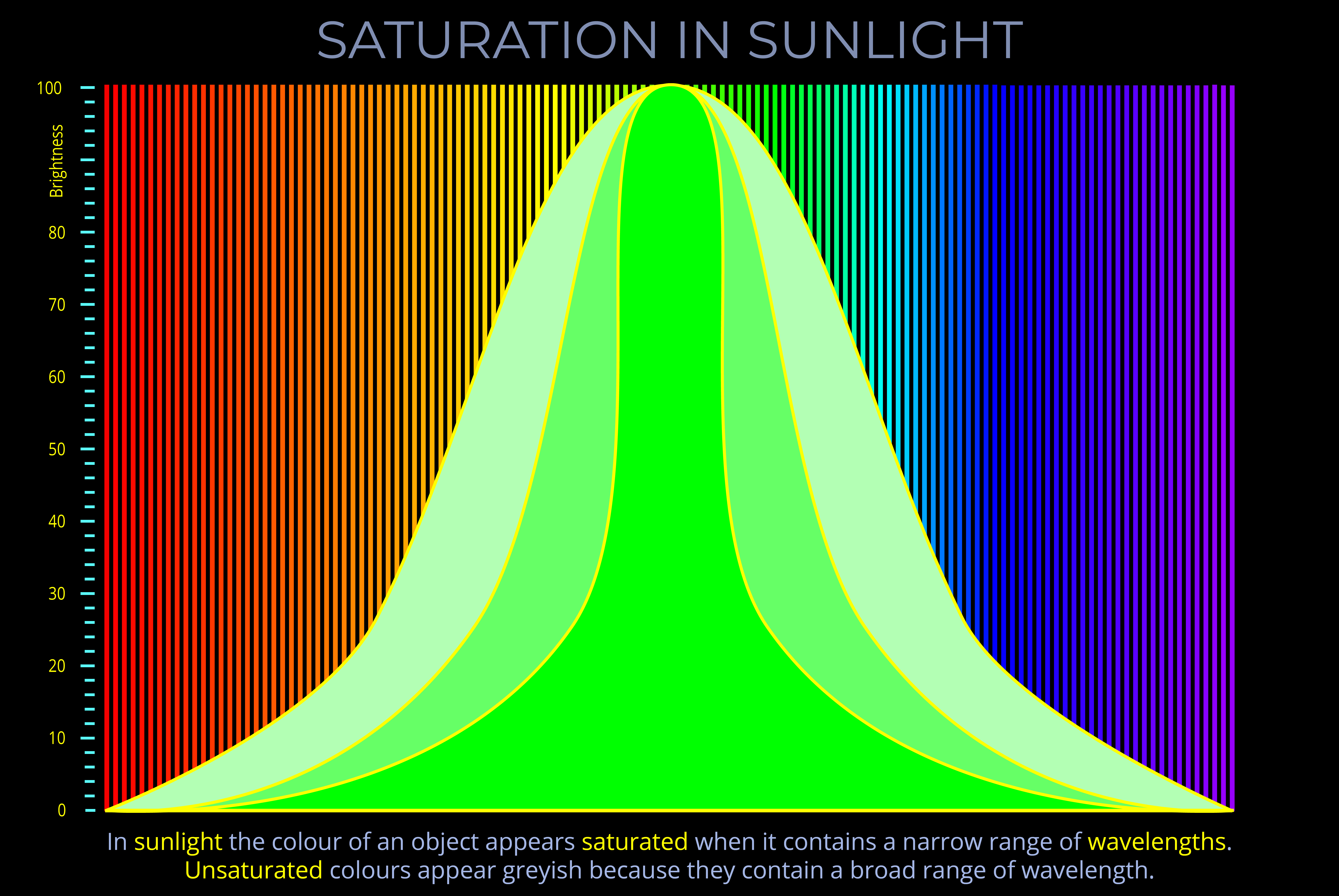
Saturation in Sunlight
TRY SOME QUICK QUESTIONS AND ANSWERS TO GET STARTED
Other names for sunlight include daylight, sunshine, visible light, light and electromagnetic radiation!
Sunlight can be described in terms of both waves and particles.
Because different wavelengths of light are reflected off the surface of objects. Every surface has unique properties.
About the diagram
Some key terms
Sunlight, also known as daylight or visible light, refers to the portion of electromagnetic radiation emitted by the Sun that is detectable by the human eye. It is one form of the broad range of electromagnetic radiation produced by the Sun. Our eyes are particularly sensitive to this specific range of wavelengths, enabling us to perceive the Sun and the world around us.
- Sunlight is only one form of electromagnetic radiation emitted by the Sun.
- Sunlight is only a very small part of the electromagnetic spectrum.
- Sunlight is the form of electromagnetic radiation that our eyes are sensitive to.
- Other types of electromagnetic radiation that we are sensitive to, but cannot see, are infrared radiation that we feel as heat and ultraviolet radiation that causes sunburn.
Saturation refers to the perceived difference between one colour and another in terms of its purity and vividness.
- A fully saturated colour appears bright and vibrant because it has a single strong dominant hue.
- A freshly cut tomato is a good example of a saturated colour with a strong red hue.
- A saturated colour is a unique spectral colour produced by a single wavelength (or a narrow band of wavelengths) of light.
- A fully saturated colour (100%) is the purest version of a hue.
- Unsaturated colours (0-10%) can appear:
- Misty or milky the nearer they are to white.
- Dull and washed out as their hue disappears leaving achromatic grey tones.
- The hue of a vivid colour appears to be at full strength and can leave an after-image of its complementary colour as an observer looks away.
Wavelength measures a complete wave cycle, which is the distance from any point on a wave to the corresponding point on the next wave.
- While wavelength can be measured from any point on a wave, it is often simplest to measure from the peak of one wave to the peak of the next or from the bottom of one trough to the bottom of the next, ensuring the measurement covers the whole of the cycle.
- The wavelength of an electromagnetic wave is usually given in metres.
- The wavelength of visible light is typically measured in nanometres, with 1,000,000,000 nanometres making up a metre.
- Radio waves, visible light, and gamma waves for example, each have different ranges of wavelengths within the electromagnetic spectrum.
Diagrams are free to download
Related products
-

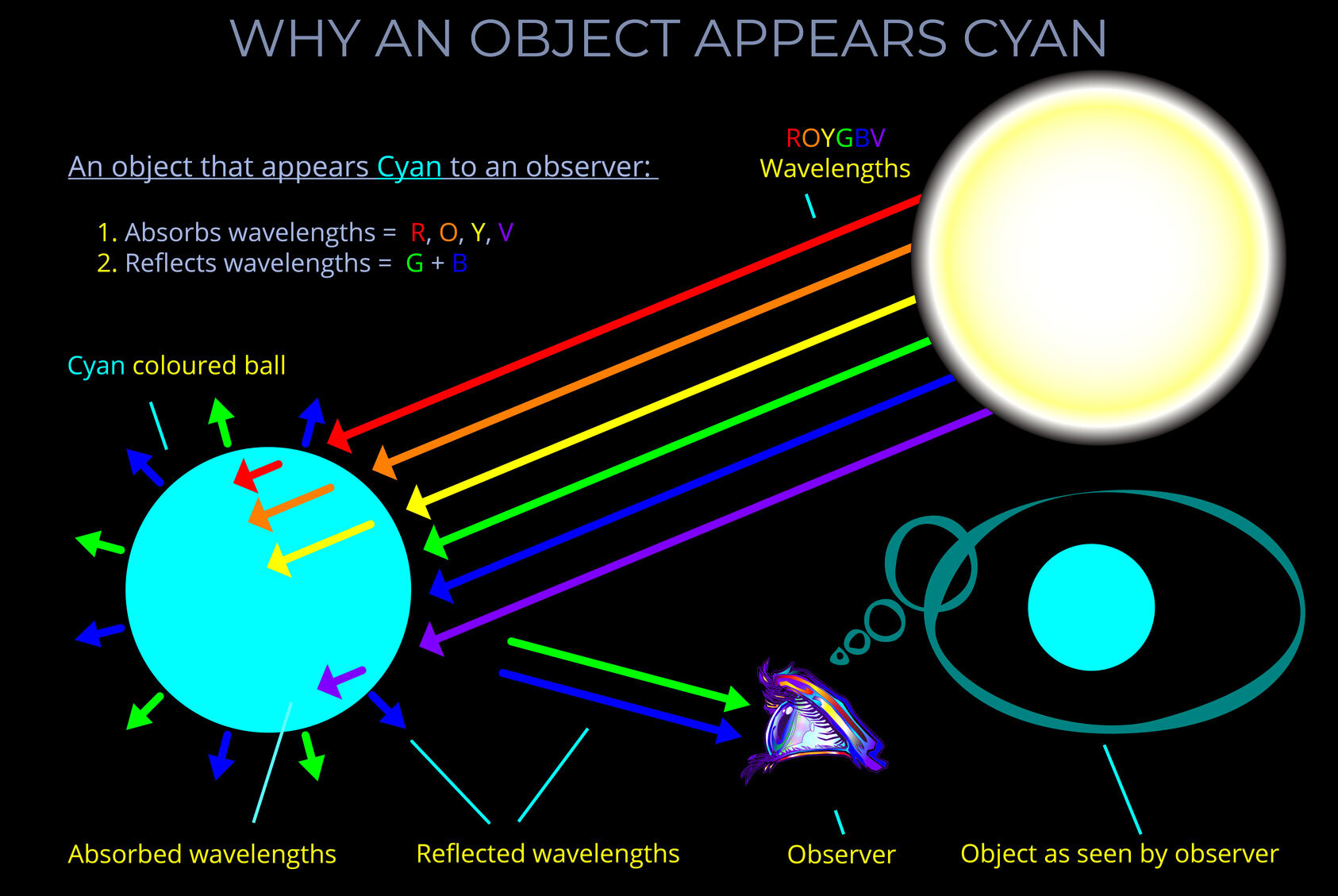
Why an Object Appears Cyan
£0.00 Select options This product has multiple variants. The options may be chosen on the product page -
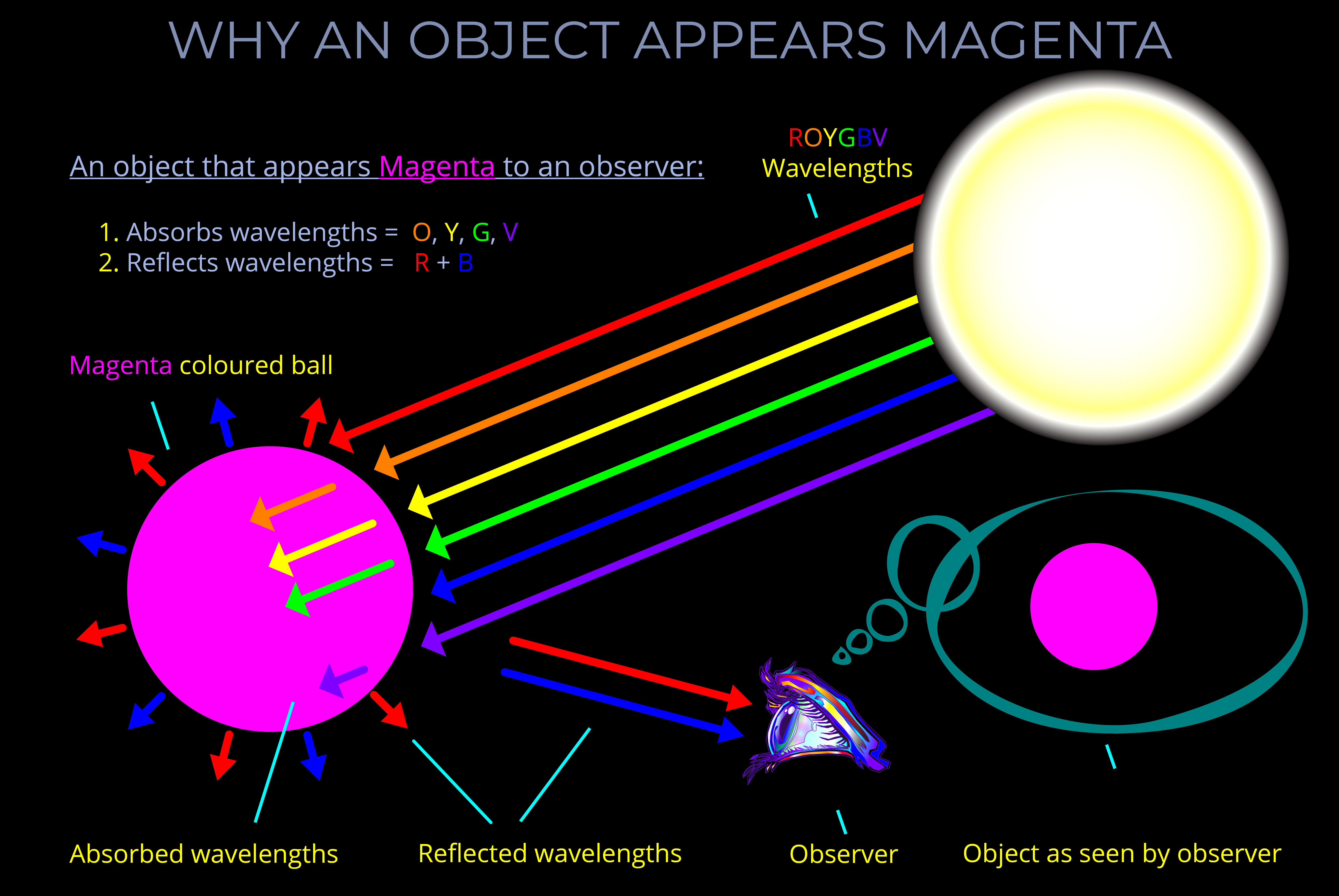
Why an Object Appears Magenta
£0.00 Select options This product has multiple variants. The options may be chosen on the product page -
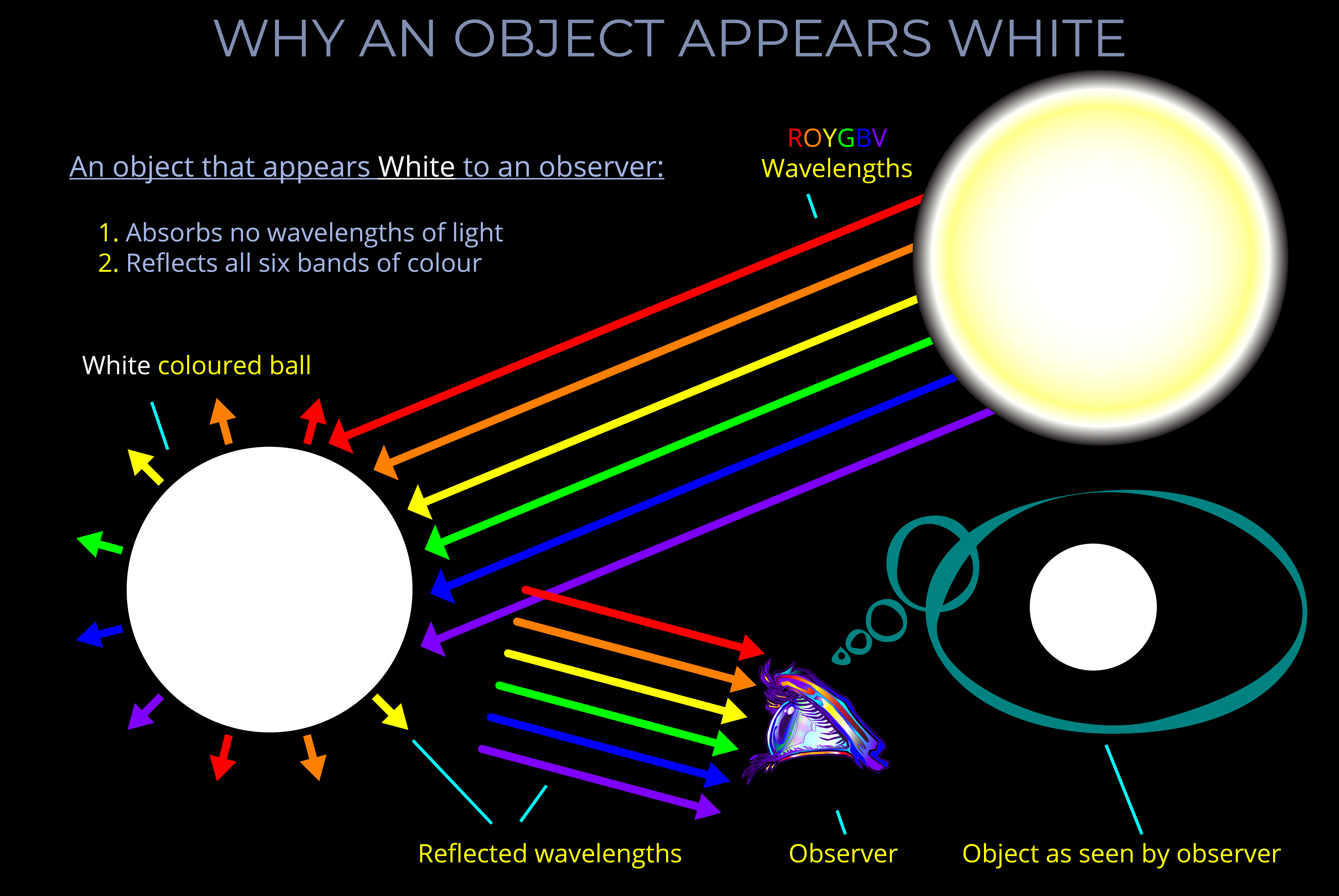
Why an Object Appears White
£0.00 Select options This product has multiple variants. The options may be chosen on the product page